Fixing EV Charging: How Enera Is Building the AI Layer for Charge Point Operators | Nicholas Marquardt, Enera
Nicholas Marquardt, co-founder and CEO of Enera, on why 29% of EV charges fail, how AI agents help charge point operators recover revenue, and why SaaS is becoming the database beneath AI.
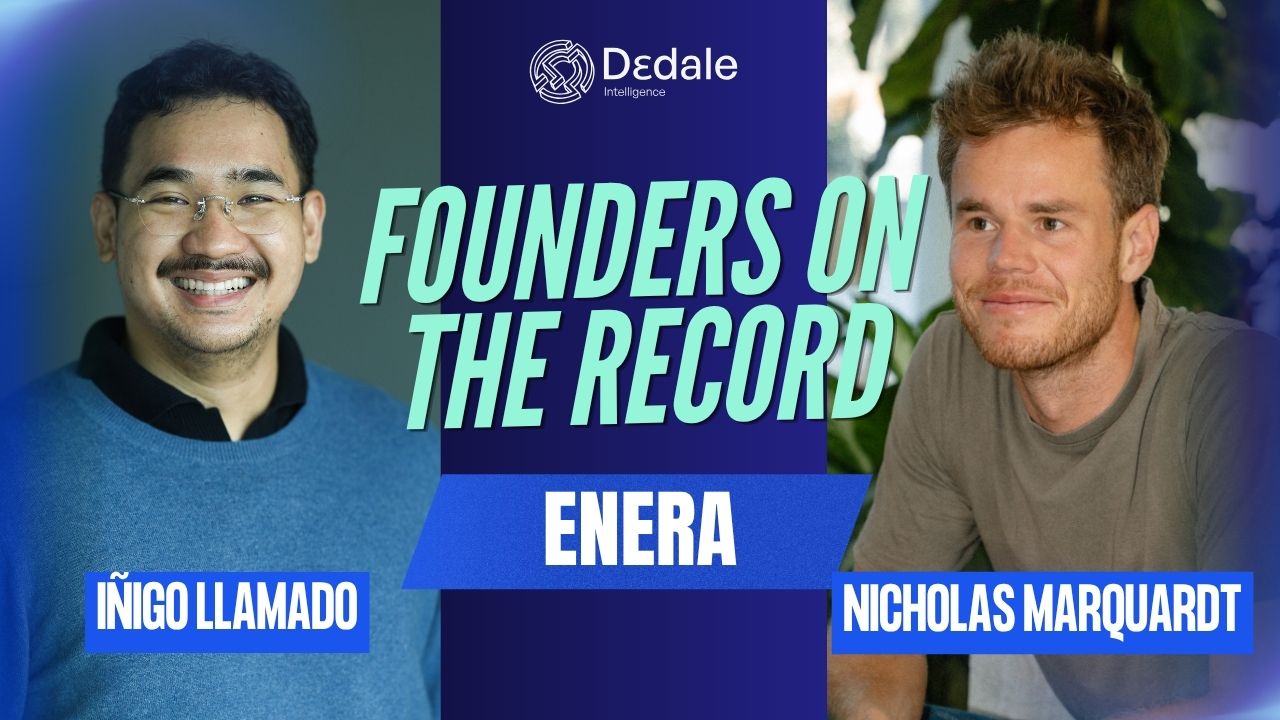
Public EV charging still fails far more often than drivers would tolerate at a gas station. Operators install chargers, run them through software and put a phone number on the side, yet many of them still cannot say why a driver walked away without charging. For Nicholas Marquardt, co-founder and CEO of Enera, that experience at the charger is “the largest barrier to EV adoption.”
In this Founders on the Record interview with Dedale Intelligence, Marquardt explains how Enera is building an AI intelligence layer for charge point operators, why demand is driven by revenue rather than regulation, and why he believes traditional software is turning into a database underneath AI.
From audio AI to the charging problem
Marquardt has spent seven or eight years in the EV space across the U.S., London and now Barcelona, including time at Arrival, a manufacturer of electric trucks and vans, and at Paua, which was building a fleet management tool for electric vehicles.
Enera did not start with the charging problem. “In reality, and this is something founders are generally advised against, I found my hammer and then looked for the nail,” he says. The hammer was audio AI. A demo of human-sounding voice agents from Sesame, a U.S. research group, convinced him that a large number of phone-based roles would move to AI. Rather than build another receptionist product for lawyers or dentists, he went back to the industry he knew.
He wrote to 200 to 300 people on LinkedIn to understand what they were struggling with, and quickly learned that call centers were a major problem for charge point operators (CPOs). That was the first of several “lightbulb moments” that are, in his words, “gradually turning us into a platform.”
Why so many charges fail
The figure Enera has seen is that 29% of charges fail. “If that happened at gas stations, it would be a major problem,” Marquardt says. Part of the reason is structural: a driver often pays through an app built by one company, which triggers a charger connected to the cloud through a charge point management system (CPMS) run by another.
Marquardt groups failures into four categories:
- Charger problems, such as a failed power module or an offline charger
- User confusion, for example not knowing that a specific car needs its door closed before charging can start
- Account problems, such as an expired card or insufficient funds
- Vehicle issues, such as a car’s battery system limiting the charge rate in cold weather
“CPOs tend to focus only on charger problems because they lack visibility into the others,” he told Dedale Intelligence, “and we aim to give them that visibility.”
An intelligence layer on top of the CPMS
“What we provide is an intelligence layer on top of the CPMS,” Marquardt says. The platform has three pillars.
The first is AI driver support. A driver who calls the number on a charger reaches an Enera agent that answers in the CPO’s name, voice and style. While one agent talks to the driver, another goes into the backend to diagnose the session, for example a payment blocked by the driver’s bank, and feeds the answer back so the driver can start charging. “The driver never hears our name or knows that we exist.”
The second is listening. Every call is recorded, transcribed and analyzed in what Enera calls the Control Room, showing why drivers called, what action was taken and whether they were charging by the end. Historically, operators received a monthly Excel file from their call center that was “often inaccurate and of little use.” Aggregated, Enera’s data can flag unusual patterns, such as a 50% jump in calls about an operator’s app after a new release.
The third pillar came from a realization this summer: most drivers never call. Enera built a network operations agent that continuously monitors for failed charges, failed chargers and underperforming chargers, creates tickets in systems such as Salesforce and Zoho Desk, and automates the resolution path, from rebooting a charger to calling the mechanic if they do not show up.
Explore more founder interviews and market intelligence in the Dedale Intelligence article library.
Revenue, not compliance
The U.K.’s Public Charge Point Regulations (PCPR) require operators to provide a 24/7 staffed helpline. Yet when asked how much of Enera’s pipeline is driven by compliance, Marquardt is clear: “Probably 100% is driven by operators wanting the data for their operations.”
The reason is economic. Support for a laptop improves an experience the customer has already paid for. “Customer support for a driver standing at your charger and trying to give you money, by contrast, unlocks revenue.” A successful call unlocks the average charging session, which he puts at £30 to £40 depending on the driver.
That matters more now than it did in the early 2020s, when CPOs raised heavily and focused on scale. With higher interest rates and less plentiful funding, operators care about the quality of their operations, and whether 70% or 80% of charges succeed makes a significant difference to revenue. Enera’s North Star is helping CPOs raise their success rate from 70% to 80% and then to 90%.
What the PCPR data revealed
One of Enera’s first moves as a company was a Freedom of Information request to the U.K. government for the PCPR reports submitted by every CPO. When the reports arrived a few months later, Marquardt says “most of the reports were wrong; the numbers did not add up.”
Operators told him enforcement was not yet happening, and he describes mandating 99% uptime as “somewhat wishful thinking.” The result is that most CPOs Enera works with keep one uptime figure for the government and another for internal operations. He sees U.K. reporting as a step in the right direction that now needs more realism, stronger enforcement and more standardization.
Keeping voice agents accurate and secure
“AI tends to hallucinate when it lacks the right context,” Marquardt says, so Enera’s answer is to make sure the agent is fed the right content. The speaking agent is in fact a swarm: a fast, simple agent talks to the driver while a larger research component queries the data and passes back conclusions. A separate quality assurance agent listens to the whole call and corrects mistakes in real time, which is why drivers sometimes hear the agent say “Sorry, I was wrong there.”
The same design creates an air gap between the agent the driver speaks to and the backend systems, so the first agent is never given information someone could persuade it to hand over.
Integrations follow a similar spirit of pragmatism. Some of Enera’s integrations use AI computer use, with an agent navigating an operator’s portal instead of an API. “In a post-AI world, integrations can look different and be more creative.”
Defensibility and a voice in every machine
What stops ElevenLabs from copying Enera? “We do not compete on being the best-sounding voice agent,” Marquardt says. The metric that matters is whether the driver got charging, and that, he argues, “means little to a player such as ElevenLabs.” Enera’s platform also takes actions, connects to ticketing systems and a backend that knows the charger intimately, and runs analysis that only EV players would care about.
He believes horizontal AI customer support players such as Parloa and ElevenLabs have focused on asset-light industries like insurance, e-commerce and banking. “No one is working on asset-heavy industries.” Internally, the team describes the long-term potential as “putting a voice in every machine,” from EV chargers to an MRI machine a nurse could troubleshoot without waiting two days for a mechanic. For now, the focus is entirely on electric vehicles. Readers interested in how AI is reshaping energy infrastructure can also see our Founders on the Record interview with Buzz Solutions.
When SaaS becomes the database
Marquardt sees a wider shift in software. Traditional SaaS products “risk being turned into databases if they are not careful,” he told Dedale Intelligence. His own example is HubSpot, which Enera uses for sales but which he rarely logs into, because Claude agents listen to his calls, update the CRM and tell him what to do next. “In effect, I have an intelligent front end that uses the traditional SaaS product as a very smart database.”
He sees Enera playing that role in EV charging: a unifying layer that pulls in data from the CPMS, the helpline, the operator’s CRM, possibly the charger itself and OCPI (Open Charge Point Interface), which is specific to the industry, with sources like Google Maps reviews still largely untapped. The next step is hiring PhD-level AI engineers to build on top of that data.
Riding the EV tailwind
Marquardt acknowledges the sense that EV adoption has slowed. Yet 30% of new vehicles in the U.K. are electric, and 98% in Norway, while only about 4% of the vehicles on Europe’s roads today are electric. He expects adoption to approach 40% to 50% over the next two decades, which would mean the industry growing 10 to 20 times.
“By making the industry more dependable, we are essentially enabling our own growth,” he says. “It is very exciting to work in an industry with that kind of tailwind behind it.”
For more on how AI is reshaping software and energy markets, explore the Dedale article library and the October 2026 Software Market Trends report.
Contact Dedale to learn more about our research coverage.
This interview was conducted by Iñigo Gabriel Llamado. Connect with Nicholas Marquardt on LinkedIn to follow Enera’s progress.
Explore our resources

Healthcare Software Market Update, 2026: Scale Beats Growth as Valuations Lag

Teaching AI About Your Brand | Francisco Vigo, CEO of geoSurge
Frequently Asked Questions
About Enera, Dedale, and EV Charging
Key questions from the Dedale Intelligence Founders on the Record interview with Nicholas Marquardt, co-founder and CEO of Enera, on EV charging reliability, AI driver support and charge point operations.
What is Enera, and how did Dedale come to cover it?
Enera is an early-stage company building an AI intelligence layer for EV charge point operators, combining AI voice agents for driver support, call analytics in its Control Room and a network operations agent that automates fault resolution. Dedale Intelligence interviewed co-founder and CEO Nicholas Marquardt as part of its Founders on the Record series, which features founders of young companies, market disruptors and recent raisers in markets relevant to PE and growth investors.
What is Dedale's Founders on the Record series?
Founders on the Record is a Dedale Intelligence interview series with founders of young companies, market disruptors and recent raisers. Each episode covers how founders build, sell and grow, the market shifts they see and the concrete implications of AI for their industries. The interview with Nicholas Marquardt of Enera is available as an article, on YouTube and on Spotify.
Why does Dedale Intelligence cover EV charging software companies like Enera?
Dedale Intelligence focuses on PE-backed and PE-relevant mid-market technology companies, including software built on top of energy and mobility infrastructure. Enera is relevant to that coverage because, as Marquardt told Dedale, 29% of charges fail and operators often cannot see why, which makes charging reliability a direct revenue lever.
Why does Enera's CEO say demand is driven by revenue rather than compliance?
Speaking to Dedale Intelligence, Marquardt said "probably 100%" of Enera's pipeline is driven by operators wanting data for their operations rather than by the U.K. Public Charge Point Regulations. A successful driver call unlocks an average charging session of £30 to £40, so better support and higher success rates translate directly into revenue.
How does Enera keep its AI voice agents from giving drivers wrong answers?
In the Founders on the Record interview with Dedale Intelligence, Marquardt explained that Enera uses a swarm of agents: a fast speaking agent, a research component that queries the data, and a quality assurance agent that listens to every call and corrects mistakes. The design also creates an air gap between the driver-facing agent and backend systems to limit cybersecurity risk.
Newsletter
Fresh insights, straight to your inbox
Trusted by 2,000+ clients
Get started
Investor, operator, or industry expert, there's a path for you.