Inside AI, SaaS & Technology Investing with Jean-Marc Prunet
What's next for AI and software? Discover key insights from Jean-Marc Prunet, Partner at Cathay Capital, on SaaS, AI disruption, and technology investing
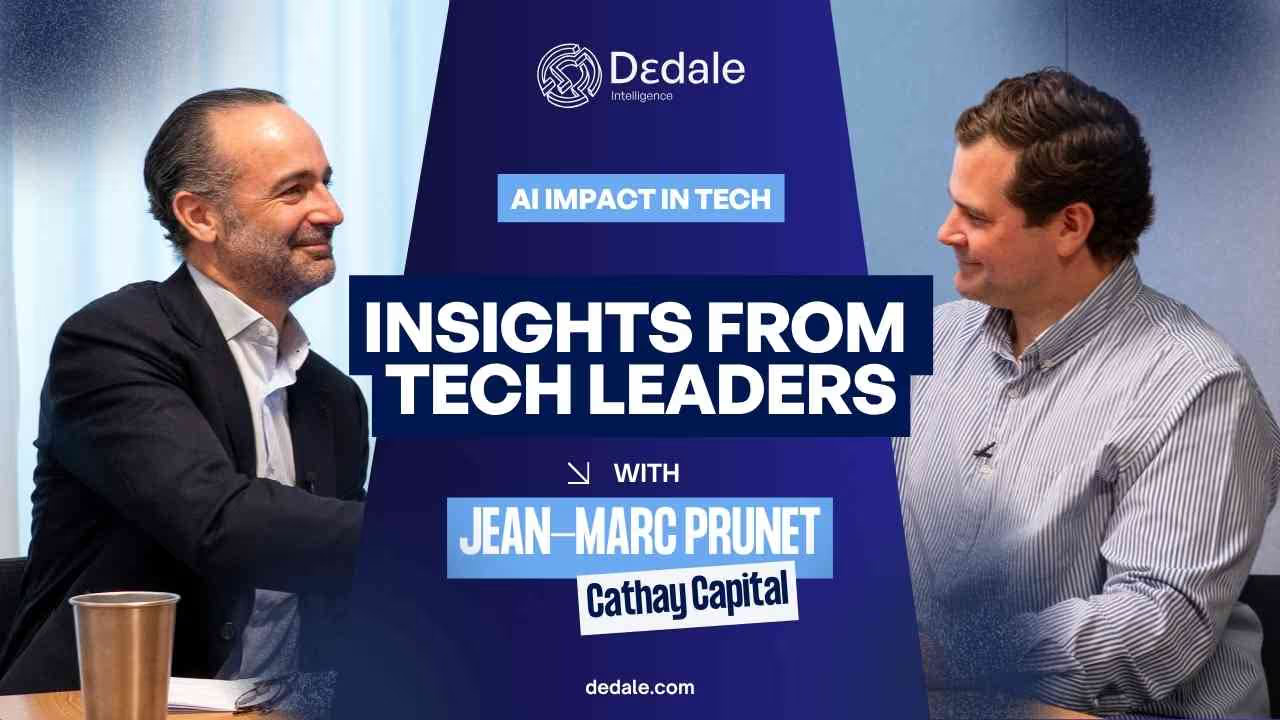
AI, SaaS & the New Investment Playbook
As AI continues to reshape technology markets, investors and executives are entering a phase of deep uncertainty, but also unprecedented opportunity.
In this new episode of our Insights from Tech Leaders series, Benjamin Forlani sits down with Jean-Marc Prunet, Partner at Cathay Capital, to explore how AI is transforming software, investment strategies, and the broader technology landscape.
🎥 Watch the full interview
🎧 Listen to the podcast
A market in transition
The conversation opens with a striking observation: while technology has long been seen as one of the most resilient and predictable sectors, recent months have challenged that assumption.
Valuations have compressed significantly, in some cases reaching levels below those seen during the COVID crisis. At the same time, AI is accelerating at a pace that makes traditional forecasting increasingly difficult.
This tension between short-term uncertainty and long-term transformation defines the current moment.
As Jean-Marc puts it:
“We’re moving from a beta play, where things evolve in a relatively linear way, to a world where you need a much more micro approach.”
In other words, broad market theses are no longer sufficient. Understanding what is happening at the level of individual companies, products, and teams has become critical.
AI as both disruption and amplification
From the very beginning of the AI wave, Jean-Marc describes a sense of both fascination and urgency.
Rather than adopting a wait-and-see approach, Cathay chose to actively engage, speaking with entrepreneurs, investors, and corporates across geographies to build a grounded understanding of what is actually changing.
The conclusion is not binary. AI is neither purely a threat nor purely an opportunity.
“This is a revolution similar to the Industrial Revolution, but for knowledge workers.”
What matters is not whether AI will reshape industries, but how companies position themselves within that shift.
Those who move early, learn fast, and adapt their models will benefit from a compounding effect. Those who hesitate risk falling behind.
Why SaaS is not dead but no longer a safe bet
One of the most debated narratives today is the idea that SaaS is coming to an end.
Jean-Marc takes a more nuanced view.
“Not all SaaS are equal. Some will be commoditized. Some will disappear. And some will win.”
The key differentiator lies in what he describes implicitly as structural advantages. Companies that have built strong positions around data, workflows, and customer context are not only more resilient, they are also better positioned to integrate AI effectively.
AI agents do not operate in isolation. They require structured environments, historical data, and governance layers. In that sense, many existing software platforms are not being replaced, they are becoming the foundation on which new capabilities are built.
Rethinking product, interfaces, and pricing
Beyond the strategic layer, AI is also reshaping how software is experienced and monetized.
Interfaces are likely to evolve from static dashboards toward more dynamic, agent-driven interactions. Software will increasingly need to interact not only with users, but with other systems and autonomous agents.
At the same time, pricing models are being questioned.
While some narratives suggest a complete shift away from traditional SaaS models, the reality is more complex. Enterprises still require predictability, and procurement constraints remain very real.
What is emerging instead is a gradual evolution toward hybrid models, where pricing reflects both access and value delivered.
As Jean-Marc notes:
“If your service creates more value, you should be able to price it accordingly.”
This introduces a subtle but important shift. Revenue is no longer just a function of adoption, it becomes increasingly tied to actual usage and outcomes.
The return of execution as the core differentiator
If there is one theme that stands out throughout the discussion, it is the renewed importance of execution.
For years, software investing benefited from strong structural tailwinds. Today, those tailwinds are still present, but they are no longer sufficient.
“Ideas and strategy are the easiest part. What is difficult is execution.”
As the cost of building software decreases, differentiation moves elsewhere, toward product quality, speed of iteration, and the ability to stay closely aligned with customer needs.
This also changes how investors approach due diligence. Beyond market size and product positioning, increasing attention is given to teams, culture, and the ability to navigate uncertainty.
In this context, CEOs are no longer just operators. They are, in Jean-Marc’s words, becoming “chief transformation officers,” responsible for driving continuous adaptation across their organizations.
Expanding the opportunity: from software to services
While much of the discussion focuses on software, one of the most forward-looking insights concerns the broader impact of AI on services.
Software has historically been a tool to improve service delivery. AI takes this one step further by enabling the automation and scaling of tasks that were previously too complex or too contextual to digitize.
This opens up a significantly larger opportunity space.
“The TAM of services is many times larger than software.”
In practical terms, this means that the next wave of value creation may not come solely from traditional SaaS companies, but from new models that combine technology, data, and service delivery in novel ways.
A more complex, but more exciting landscape
The overarching takeaway from this conversation is not one of pessimism, but of increased complexity.
The software playbook is not disappearing, it is evolving.
Success now requires a deeper understanding of markets, a stronger focus on execution, and a willingness to operate in a more uncertain environment.
But for those who can navigate this complexity, the upside remains significant.
About the series
This interview is part of our Insights from Tech Leaders series, where we speak with leading operators and industry experts across global software markets.
At Dedale Intelligence, we support investors and corporates in navigating complex technology markets and building conviction in fast-evolving environments.
To go deeper, you can explore our latest report, AI Models & Architecture Overview, which maps the 5-layer AI ecosystem, from GenAI to AI agents, and highlights key innovation and investment opportunities across the stack.
About Cathay Capital
Cathay Capital is a global private equity and venture capital investment firm supporting healthcare, technology and consumer companies throughout North America, Europe, and Asia. The firm helps middle-market companies and startups navigate opportunities for growth, international expansion, and sustainable transformation. Cathay is the partner of choice for companies aspiring to lead markets and make a positive impact. Its platform connects people with global reach and local expertise – from investors and entrepreneurs to management teams and leading corporations – to share knowledge, the tools to scale and to transform businesses.
Founded in 2007 with a strong entrepreneurial heritage, Cathay Capital now manages more than $6 billion in assets. It has made over 300 investments in verticals including healthcare, technology, and consumer from offices in New York, San Francisco, Paris, Munich, Berlin, Madrid, Shanghai, Beijing, and Singapore.
For more information, visit: www.cathaycapital.com.

Explore our resources

How Sagard works on supply chain software with Dedale

AI, Grid Inspection & the AI-Ready Utility with Vikhyat Chaudhry (Buzz Solutions)
Frequently asked questions
AI and SaaS Investing: Common Questions
Answers to the most common questions from Dedale's interview with Jean-Marc Prunet, Partner at Cathay Capital.
Is SaaS as an investment category dead?
No. Jean-Marc Prunet argues not all SaaS is equal: some categories will be commoditized or disappear, while companies with strong positions around data, workflows, and customer context are more resilient and better positioned to integrate AI.
How does Cathay Capital approach the current AI moment?
By actively engaging rather than waiting, speaking directly with entrepreneurs, investors, and corporates across geographies to build a grounded, company-level understanding of what is actually changing.
What does Jean-Marc Prunet compare the AI shift to?
A revolution similar to the Industrial Revolution, but for knowledge workers, where companies that move early and adapt fast benefit from a compounding effect.
Newsletter
Fresh insights, straight to your inbox
Trusted by 2,000+ clients
Get started
Investor, operator, or industry expert, there's a path for you.