The Evolving Role of the CFO: Key Trends and Insights
Explore how the Office of the CFO is evolving through financial management software, hybrid systems, and key market trends shaping modern finance teams

How the Office of the CFO Is Evolving: Software, Trends & Insights
Office of the CFO is no longer just responsible for reporting and compliance. It has become a central decision-making function, influencing strategy, operations, and long-term growth.
As financial environments grow more complex, CFOs are expected to manage not only financial performance, but also data, systems, and cross-functional alignment.
What is driving this shift is not just organizational change, it is the rapid evolution of financial management software ecosystems.
This shift is a core focus area for Dedale Intelligence, where we analyze how financial systems, tools, and organizational structures evolve across industries.
What the Office of the CFO Actually Covers Today
At its core, the CFO oversees the company’s financial health, ensuring alignment between financial strategy and business objectives. But in practice, the scope is expanding.
Beyond traditional responsibilities like planning, reporting, cash flow management, and financial control, the CFO increasingly interacts with:
- Procurement and vendor management
- Operational decision-making
- Cross-department data flows
This reflects a broader reality: financial decision-making is no longer isolated. It is deeply interconnected across the organization.
Why Financial Management Is Becoming a System Problem
Financial management today is an ecosystem.
It spans the entire reporting cycle:
- Planning and forecasting at the start
- Execution and transaction tracking during operations
- Consolidation and reporting at the end
In most organizations, this involves multiple systems across Accounting, Treasury, Billing and payments, and Financial planning.
The challenge is not the lack of tools but the lack of cohesion between them. This is where most organizations start realizing they don’t have a true financial architecture, only disconnected tools. This challenge is further amplified by the increasing reliance on external data ecosystems, particularly in financial markets, where data complexity continues to grow.
At Dedale Intelligence, this fragmentation is one of the most recurrent patterns observed across financial ecosystems, often limiting the effectiveness of even the most advanced tools.
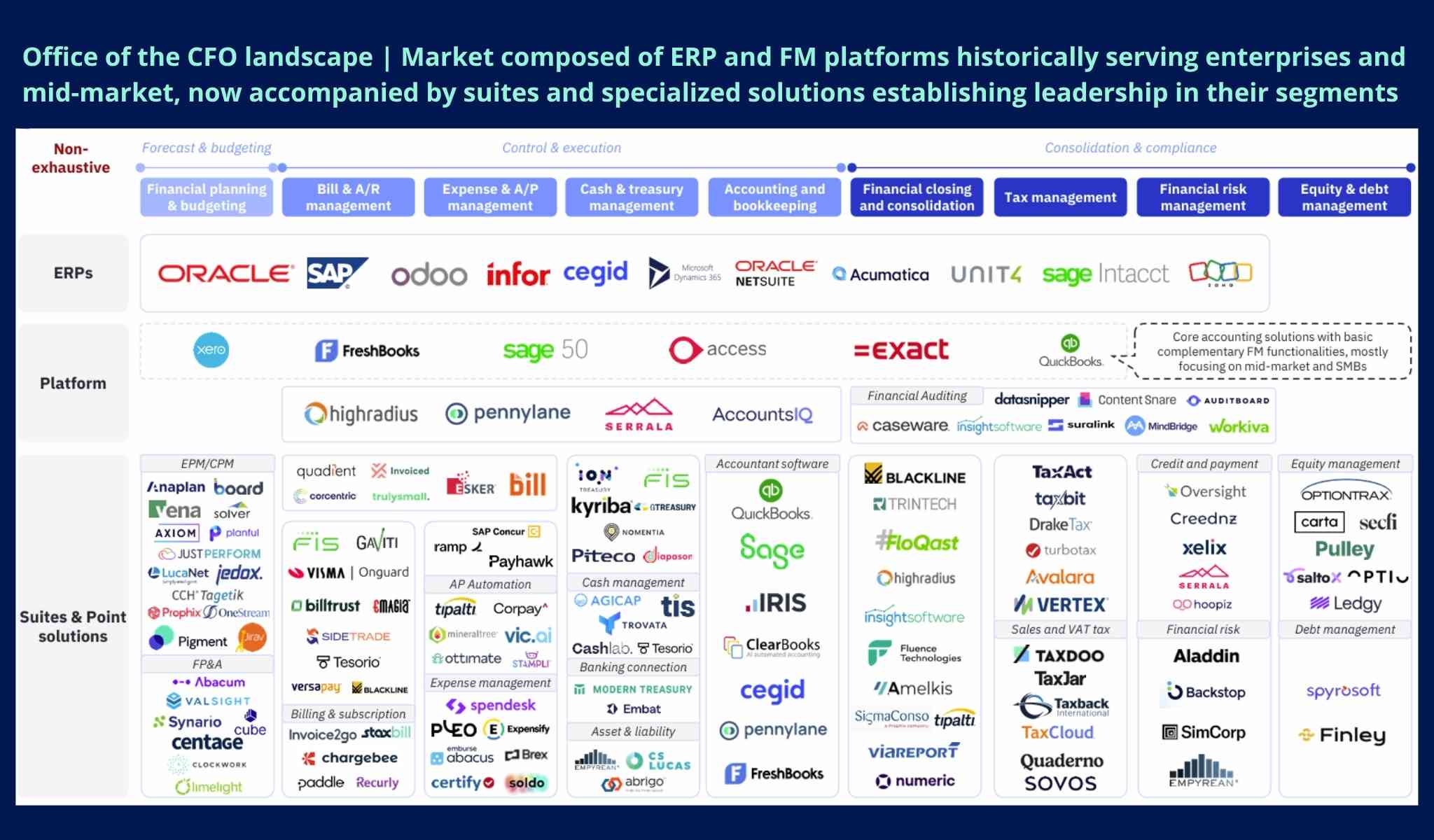
If you’re exploring how leading companies structure this ecosystem end-to-end, this is covered in depth in our full research report on Office of the CFO.
The Shift Toward Hybrid Financial Architectures
One of the most important structural shifts is the move toward a hybrid model.
Instead of relying entirely on one ERP system (limited flexibility), or multiple fragmented tools (high complexity), companies are combining both:
- ERP systems for coverage and integration
- Specialized tools for depth and performance
This hybrid approach is gaining traction because it balances Functionality, Scalability, and Cost efficiency. This is now becoming the default architecture for financial systems.
Where Most CFO Offices Still Struggle
Despite technological progress, core issues remain surprisingly consistent.
The most common challenges are systemic:
- Financial data is spread across multiple systems, making it difficult to create a single source of truth
- Manual processes still dominate critical workflows, slowing operations and increasing error risks
- Many tools lack the capabilities required for modern finance, especially in analytics and scalability
- Implementations are often complex, resource-intensive, and disruptive
These challenges are not just operational since they directly impact decision quality and speed.
A Growing Market, But Still Fragmented
The financial management software space represents a ~€30 billion market, with continued growth driven by digitalization and increasing adoption of specialized tools.
However, the market remains:
- Fragmented at SMB and mid-market levels
- More concentrated at enterprise level
- Strongly influenced by local regulations and requirements
This fragmentation is exactly why navigating the space is difficult without structured intelligence.
The Trends Redefining the CFO Function
Several structural shifts are shaping the future of finance:
- Financial processes are being digitized and automated, reducing manual effort and enabling real-time operations.
- Data is becoming a strategic asset, with analytics playing a critical role in decision-making. This shift is closely linked to the increasing role of artificial intelligence in financial decision-making, as explored in more detail in our analysis of how AI is transforming the Office of the CFO.
- Traditional ERP systems are losing their dominance as companies adopt more flexible, specialized solutions.
At the same time, increasing regulatory complexity and internal resistance continue to slow transformation.
The result is a paradox: More tools are available than ever, yet building an effective system is becoming harder.
What This Means in Practice
The companies moving the fastest are not the ones adopting the most tools.
They are the ones:
- Structuring their financial systems intentionally
- Connecting data across functions
- Prioritizing decision-making speed and accuracy
This is where the Office of the CFO is evolving: from financial control to strategic intelligence.
At Dedale Intelligence, we provide strategic intelligence across 1000+ software markets, including deep dives into financial management ecosystems, vendor landscapes, and technology trends. If you are evaluating your current setup or exploring this space, contact us to access the full research or explore our platform.

Explore our resources

AI in GovTech: A Low-Disruption Market Where Incumbents Hold the Advantage

The SaaSPocalypse & What Comes Next with Vladimir Lasocki (Carlyle)
Frequently asked questions
The Office of the CFO: Common Questions
Answers to the most common questions about how financial management software is reshaping the Office of the CFO.
How has the CFO's role expanded beyond traditional finance?
Beyond planning, reporting, cash flow management, and financial control, CFOs increasingly interact with procurement and vendor management, operational decision-making, and cross-department data flows.
Why is financial management becoming a system problem?
Most organizations run multiple systems across accounting, treasury, billing and payments, and financial planning. The challenge is not a lack of tools but a lack of cohesion between them, leaving many organizations without a true financial architecture.
What is the hybrid financial architecture trend?
Companies are moving away from relying entirely on one ERP system or multiple fragmented tools, instead combining ERP systems for coverage and integration with specialized tools for depth and performance, balancing functionality, scalability, and cost efficiency.
Newsletter
Fresh insights, straight to your inbox
Trusted by 2,000+ clients
Get started
Investor, operator, or industry expert, there's a path for you.