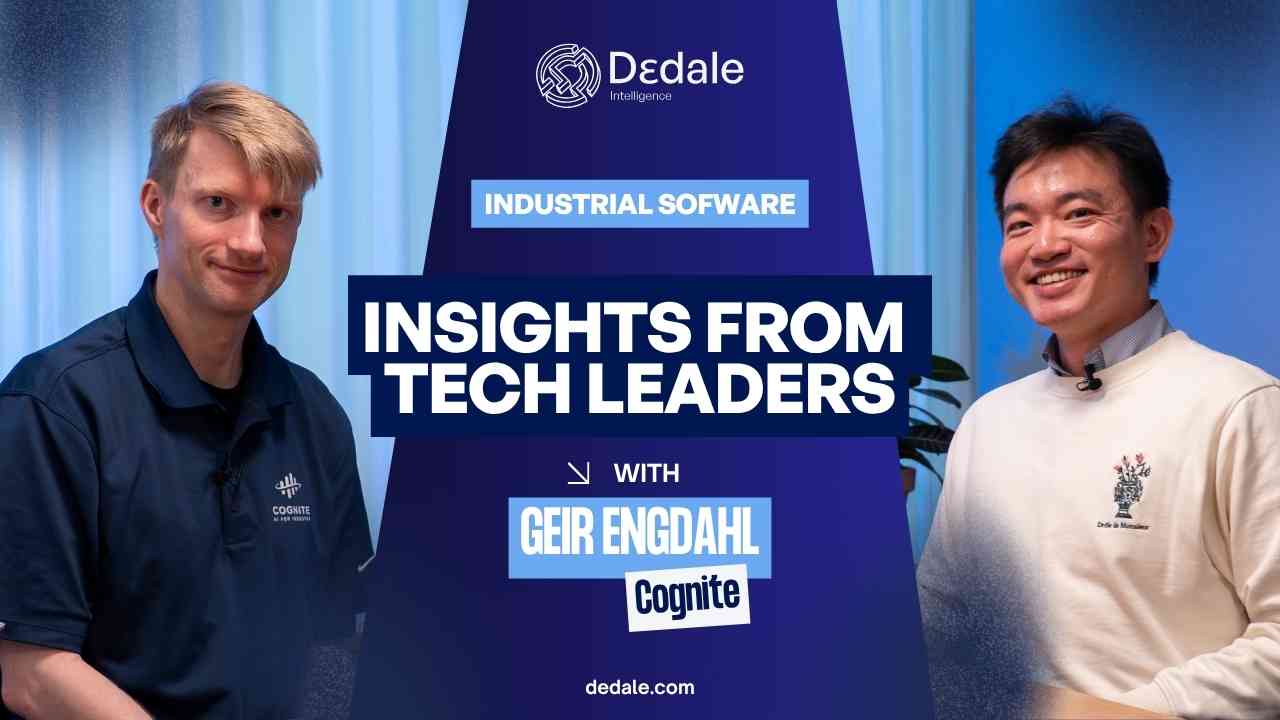
Industrial AI & the Future of Industrial Software with Geir Engdahl
Discover key insights from Geir Engdahl, Co-founder & CTO of Cognite, on industrial data, agentic AI, and the future architecture of asset-heavy industries.
Industrial AI at an Inflection Point
Asset-heavy industries, energy, manufacturing, utilities, sit on some of the world's most valuable operational data. And yet most of it remains trapped in fragmented legacy systems, inaccessible to the AI tools that could unlock its value. The question is no longer whether AI will transform industrial operations, but what the data foundation needs to look like for that transformation to actually scale.
In this new episode of our Insights from Tech Leaders series, Junhao Wang, Senior Manager & Industrial Software at Dedale, sits down with Geir Engdahl, Co-founder & CTO of Cognite, to explore what it really takes to deploy AI at scale in industrial environments, and where the disruption risk lies for incumbent software vendors.
🎥 Watch the full interview
🎧 Listen to the podcast
From Google to Cognite: the data problem nobody had solved
Geir Engdahl's path to industrial AI is anything but conventional. After studying applied mathematics and spending three years at Google building machine learning models for advertising, where correlated, well-structured data made model training straightforward, he co-founded Snapsale, a classifieds app using image recognition to automate listings. When he joined the founding team at Cognite in 2016, he brought an outsider's eye to a sector that had never been forced to solve its data problem.
That problem, as Geir quickly discovered, was structural. Industrial businesses are physical. Their operations generate data across hundreds of legacy systems, SCADA, DCS, historians, MES, ERP, engineering drawings, built over decades, in different formats, with no common data model. Where Google's advertising data sat in the same place, in the same format, perfectly correlated, industrial data was scattered, siloed, and incomplete.
"I came from the outside with this really naive belief that we would apply machine learning to industrial data and create a lot of value."
The reality required a different approach. Before AI could deliver on its promise, the data foundation had to be built.
The two fundamental blockers to scaling AI in industry
Cognite's thesis, and its product, is rooted in a clear diagnosis of why industrial AI consistently stalls after proof of concept.
The first blocker is the probabilistic nature of AI itself. In an environment where the tolerance for error is extremely low, where a wrong output can mean unplanned downtime, safety incidents, or regulatory exposure, deploying AI without hard guardrails is not an option. Every use case has to be selected with this in mind.
The second blocker is scale. It is one thing to build an AI model that monitors a single pump. It is another to deploy that capability across thousands of pieces of equipment, at dozens of sites, in different geographies, with different legacy systems. Without a consistent, normalized data layer underneath, every deployment is effectively a new project.
"You may solve it for one pump, but what about the thousands across your entire fleet?"
Cognite Data Fusion addresses both blockers by extracting data from source systems, contextualizing it into a consistent data model, and making it available for AI, applications, and analysts, regardless of where it came from.
Where AI creates real value today: maintenance operations and root cause analysis
With the data foundation in place, Geir is clear-eyed about which use cases are ready for production deployment and which remain aspirational.
The most mature area is maintenance operations. Root cause analysis, the process by which engineers diagnose what went wrong after an incident, can now be compressed from months to half a day using AI agents. Rather than manually gathering data from multiple systems, an agent creates what Cognite calls a cause map: a tree of hypotheses tested against actual operational data. The engineer reviews and validates; the AI does the heavy lifting.
Planned turnaround management is another high-value area. When unplanned downtime occurs, companies lose the luxury of months of preparation. AI can replicate that level of planning in minutes, identifying the right parts, the right certified technicians, the right sequencing, and significantly reduce the disruption.
Then there is alarm management. Industrial control rooms are often flooded with hundreds of muted alarms, a symptom of alarm fatigue built up over years. The operator with 20 years of experience knows which sensor to ignore. But those operators are retiring. Geir sees a major opportunity in training industrial large models, multimodal systems that ingest time series, work orders, engineering drawings, and data sheets, to surface only the alarms that actually require attention, and to chain that signal directly into a root cause analysis agent.
"You could have one model that understands the context, sees that something looks like an anomaly, and then triggers the root cause analysis agent."
Closing the loop: from intelligence to action
One of the most significant shifts Cognite is seeing is the move from read-only intelligence to write-back action. Customers increasingly want agents that not only diagnose a problem but draft a work order, route it for approval, and push it directly back into SAP or their CMMS system, closing the loop between insight and execution.
This is the architecture Geir describes as the future of industrial operations: a deterministic platform layer that holds the system of record, combined with probabilistic AI agents that operate within carefully defined guardrails, and increasingly write back to source systems with human approval in the loop.
He illustrates the principle with a personal example: two Raspberry Pis at home, one running an AI agent with no access to sensitive data, the other a deterministic system pre-configured to expose only specific, approved information. The agent can ask questions; it cannot overwrite reality.
"There's a deterministic layer and a non-deterministic layer where AI can do its thing."
At industrial scale, this architecture becomes the foundation for safe, auditable AI deployment, where agents can optimize valve set points every minute rather than once a day, but only within a safe envelope defined by the control system itself.
The disruption map: which software categories are most at risk?
The conversation turns to the question PE investors ask most: which incumbent industrial software categories face the greatest disruption risk from AI?
Geir's framework is built around one axis: proximity to error-intolerant systems. The closer a software category sits to the control layer, where deterministic, auditable outputs are non-negotiable, the harder it is to displace. The closer it sits to the UI layer, where customization and flexibility matter more than precision, the more vulnerable it is.
Most at risk:
- Enterprise historians: customers are already bypassing them by connecting directly via OPC UA. LLM-like architectures applied to time series can one-shot anomaly detection without training on specific equipment, making them inherently more scalable.
- PLM systems: customers are already building PLM functionality on Cognite Data Fusion. The value of a document management layer with embedded logic is diminishing as platform-native alternatives mature.
- MES and field service management (ServiceMax, IFS, similar): Geir sees limited structural moat in the data or workflows these systems manage. With a good data foundation and agentic application building, these categories are increasingly buildable from scratch.
More defensible:
- CAD and simulation software: rooted in deep physics knowledge and parametric engineering rules, with near-zero tolerance for error. These are not areas where probabilistic AI can easily compete on accuracy.
- Control systems: the lowest layer of the stack, deterministic by design, and unlikely to be displaced anytime soon. The opportunity here is not to replace them, but to connect to them and eventually write back safely.
"The most difficult things to disrupt with AI are those very close to the low-error-tolerance parts."
The industrial tech stack in five years
Looking ahead, Geir expects the future industrial enterprise to operate with a clearly separated architecture: a deterministic platform layer, what Palantir calls ontology, what Cognite calls a knowledge graph, and a probabilistic AI layer sitting on top.
Agents will become by far the largest user group of industrial platforms. They do not need user interfaces; they need APIs and MCP-style connectors. That shift will redefine what enterprise software seats look like and how platforms are monetized.
At the same time, the enterprise will not standardize on a single agentic framework. Azure AI Agent Studio, AWS, Databricks, SAP, customers will run agents across multiple environments. The platforms that win will be those with the openness to serve all of them, and the data gravity to remain at the centre.
"Agents will be by far the largest user group of your platform. Those are going to be the seats of the future."
Scalability: from proof of concept to fleet-wide deployment
The final challenge Geir addresses is the one that has historically separated industrial AI pilots from industrial AI at scale: the cost and complexity of site-by-site deployment.
Cognite's answer is the data model itself. Once a site is onboarded, connectors established, data quality validated, pipelines running, it feeds into the same normalized data model as every other site. Applications built on top do not need to be rebuilt when moving from site A to site B. They already work.
Agentic AI is now accelerating the onboarding process itself. More and more of the setup work that previously required human services teams, configuring pipelines, testing data quality, validating logic, is being handled by LLMs. Deployment timelines are coming down.
"When you build an application on top of this, you don't need to rebuild it when you go from site A to site B. It already works."
About the series
This interview is part of our Insights from Tech Leaders series, where we speak with leading operators and industry experts across global software markets.
At Dedale, we support investors and corporates in navigating complex technology markets and building conviction in fast-evolving environments.
About Cognite
Cognite is a global leader in industrial AI, purpose-built to help asset-heavy industries unlock the value of their operational data. Its platform, Cognite Data Fusion®, connects and contextualizes data from hundreds of industrial source systems, making it AI-ready at scale. Cognite serves customers across energy, manufacturing, and power & renewables from offices worldwide.
For more information, visit: www.cognite.com

Explore our resources
.jpg)
The Operating System for Indices: How PANTA Is Modernizing the Index Industry | Tobias Sproehnle, PANTA
.jpg)
Frequently asked questions
Industrial AI: Common Questions
Answers to the most common questions from Dedale's interview with Geir Engdahl, Co-founder and CTO of Cognite.
What is the biggest blocker to scaling AI in industrial environments?
Two blockers stand out: the probabilistic nature of AI itself in low-error-tolerance environments, and the challenge of scaling a working AI model from one piece of equipment to thousands across multiple sites without a consistent, normalized data layer.
Why is industrial data harder to work with than data used in consumer AI?
Industrial data is scattered across hundreds of legacy systems, including SCADA, DCS, historians, MES, and ERP, built over decades in different formats with no common data model, unlike advertising data which sits in one place in a consistent format.
What did Geir Engdahl learn moving from Google to Cognite?
That industrial AI required building the data foundation first. Before AI could deliver value, industrial businesses needed a normalized data layer to bridge fragmented legacy systems.
Newsletter
Fresh insights, straight to your inbox
Trusted by 2,000+ clients
Get started
Investor, operator, or industry expert, there's a path for you.