US Electronic Health Records Software: A $16-18 Billion Market at an Inflection Point
Dedale's segment primer on the US EHR software market covers the $16-18 billion landscape, the acute vs. ambulatory divide, key purchasing criteria, competitive dynamics, and where AI is reshaping clinical workflows.

Electronic Health Record software is not a discretionary IT investment in the US healthcare system. It is federally mandated, operationally central, and virtually impossible to replace once embedded. That combination of regulatory necessity and deep workflow integration has produced one of the stickiest markets in enterprise software, and one of the most structurally interesting for investors evaluating healthcare technology.
Dedale Intelligence's US EHR Software Segment Primer draws on 20 primary expert interviews conducted across Epic alumni, Athenahealth executives, GE Healthcare directors, and senior clinical leaders at OhioHealth, NYU Langone Health, Mount Sinai, and SouthCoast Health. This article draws selectively on those findings. For broader context on how EHR sits within the wider healthcare software ecosystem, see Dedale Intelligence's expert interview on HealthTech and the Digital Transformation of Healthcare IT report.
Two markets inside one category
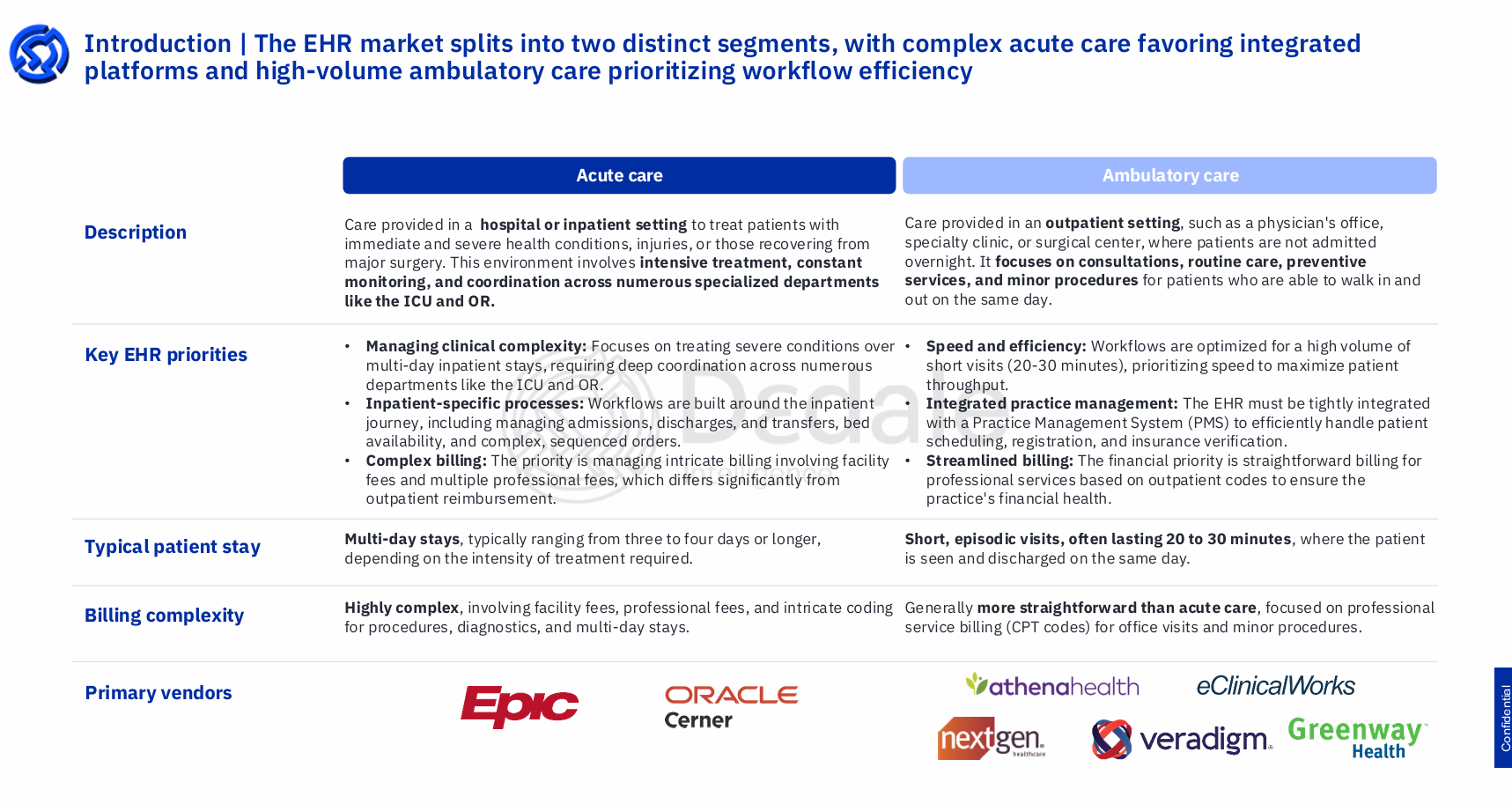
The EHR market is fundamentally split into two ecosystems with very different buyer priorities.
Acute care covers inpatient hospital settings where patients stay for multi-day episodes, typically three to four days or longer, involving intensive treatment and coordination across ICU, OR, and specialized departments. Billing is highly complex. The priorities for acute care EHR buyers are interoperability across vast hospital networks, an all-in-one platform covering every department, clinical specificity, and above all vendor reliability. For mission-critical systems, risk aversion is extremely high.
Ambulatory care covers outpatient settings where patients are seen and discharged the same day, with visits typically lasting 20 to 30 minutes. The priorities flip entirely: speed and workflow efficiency come first, total cost of ownership is the most critical purchasing factor for independent practices, and ease of use drives adoption in small, non-technical teams.
Interoperability is the one demand that cuts across both segments. As the OB-GYN Medical Director at OhioHealth told Dedale Intelligence: "Interoperability is probably forefront on everyone's minds right now for communication purposes."
Purchase decisions are led by the C-suite. The CIO is typically the lead stakeholder, the CEO must be fully behind the decision, and the CMO and department heads provide clinical validation.
A $16-18 billion market in a replacement and optimization phase
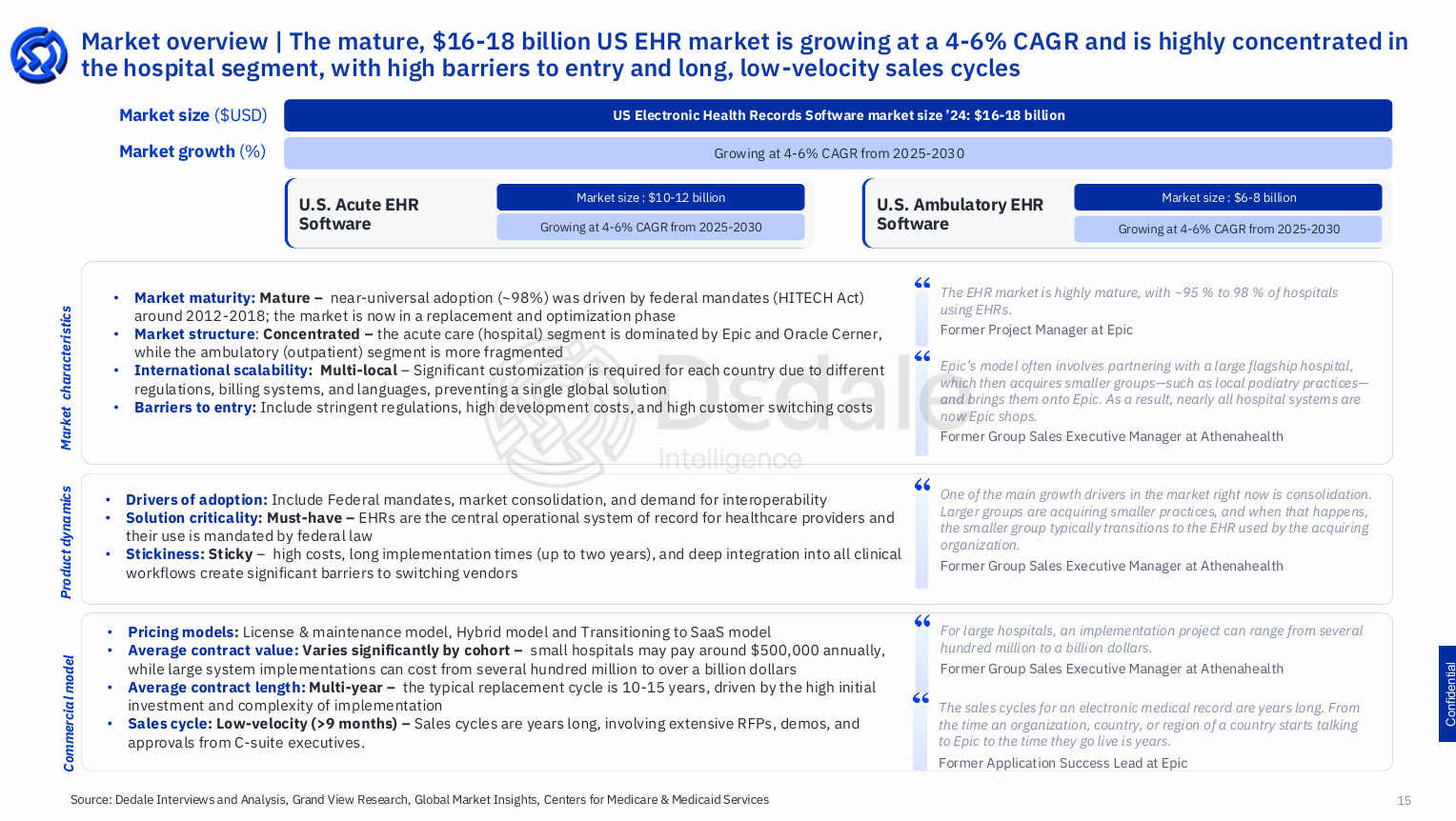
The US EHR software market is a mature, $16-18 billion market growing at 4-6% CAGR from 2025 to 2030. The acute care segment accounts for $10-12 billion; the ambulatory segment for $6-8 billion. Both grow at 4-6% CAGR.
Near-universal adoption, at 95% to 98% of US hospitals, was driven by federal mandates under the HITECH Act between 2012 and 2018. The market is now firmly in a replacement and optimization phase, not greenfield adoption.
The commercial model reflects the strategic weight of these systems. Small hospitals pay around $500,000 annually. Large system implementations cost from several hundred million to over a billion dollars. Replacement cycles average 10 to 15 years. Sales cycles are years long, involving extensive RFPs, demonstrations, and C-suite approvals.
Three tailwinds sustain growth: AI and automation integration creating significant upsell opportunities; the shift to value-based care making EHR data financially essential; and provider consolidation, which forces acquired entities onto the incumbent system and creates a predictable replacement cycle. Two structural headwinds keep the pace measured: high switching costs and customer stickiness, where even unsatisfied users rarely switch; and persistent interoperability challenges that continue to frustrate coordinated care.
Download the full US Electronic Health Records Software Segment Primer
Where AI is taking EHRs
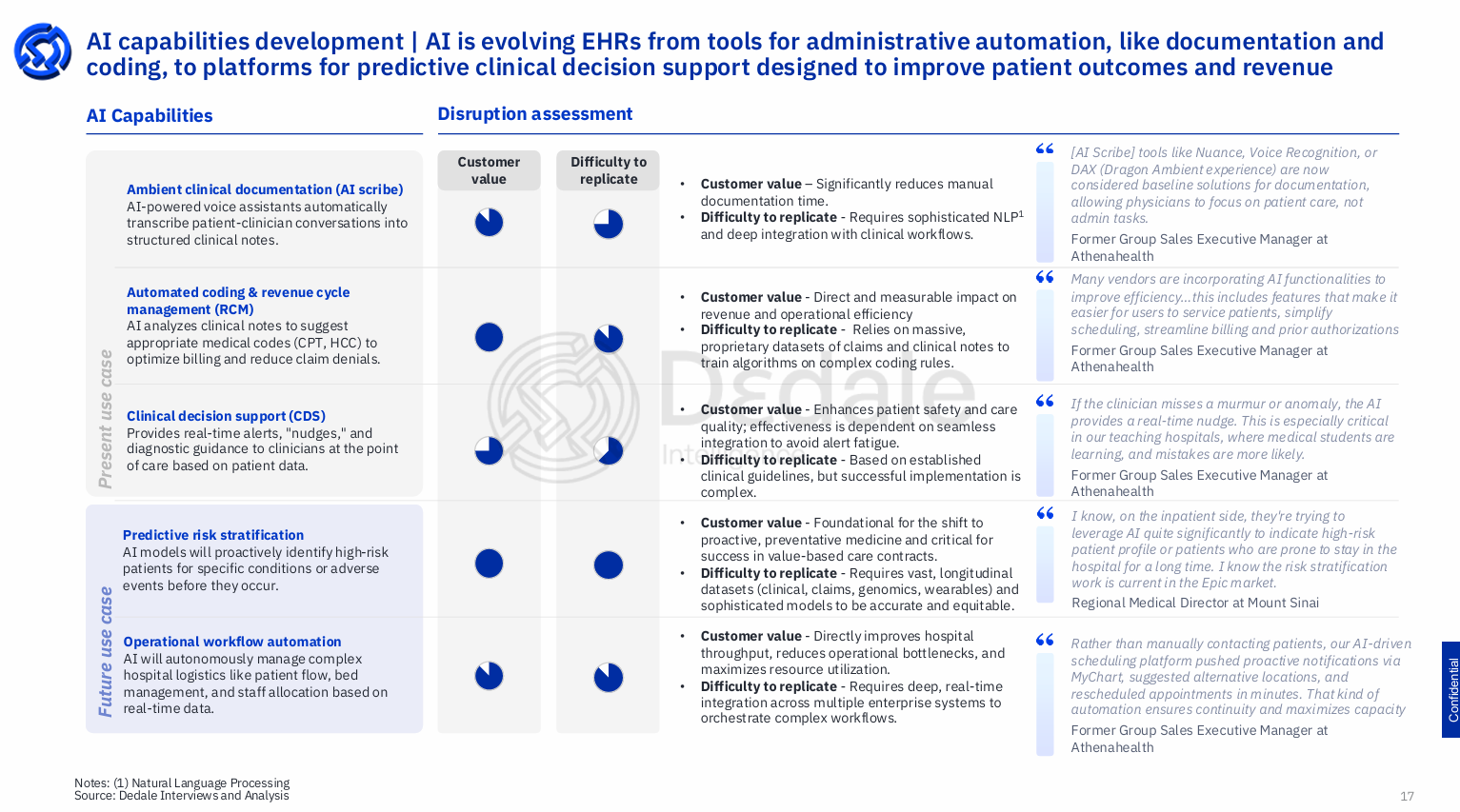
AI is moving EHRs from administrative tools toward platforms for predictive clinical decision support. Three use cases are already in deployment. Ambient clinical documentation uses AI-powered voice assistants to transcribe patient-clinician conversations into structured clinical notes, significantly reducing manual documentation time. Automated coding and revenue cycle management uses AI to analyze clinical notes and suggest appropriate medical codes, optimizing billing and reducing claim denials. Clinical decision support provides real-time alerts and diagnostic guidance to clinicians at the point of care.
Two use cases represent the next frontier. Predictive risk stratification will proactively identify high-risk patients before adverse events occur, foundational for value-based care contracts. Operational workflow automation will autonomously manage patient flow, bed management, and staff allocation based on real-time data. On pricing, consumption-based components tied to AI-powered services are expected to layer on top of existing SaaS fees, creating a new upsell layer for incumbent vendors.
The competitive landscape: Epic leads, the battle lines are shifting
In acute care, Epic is the clear leader for large hospitals, holding approximately 95% of this segment according to a Former Project Manager at Epic interviewed by Dedale Intelligence. Oracle Cerner is the major alternative, typically costing approximately 35% to 40% less than Epic on a total cost of ownership basis. Epic's dominance was built on a single homegrown database where every module talks to every other natively, with no acquired integrations.
In ambulatory care, the market is more fragmented. Athenahealth leads as the primary cloud-based EHR and revenue cycle management provider for outpatient practices, with over 160,000 clinicians on the platform. eClinicalWorks serves small to mid-sized practices with $900 million in FY 2023 revenue. Nextgen Healthcare, recently taken private by Madison Dearborn Partners through an LBO on June 6, 2025, generated $653 million in FY 2023 revenue.
Three dynamics are actively reshaping the landscape. Provider consolidation forces acquired entities onto the acquirer's incumbent EHR, creating a predictable replacement cycle. Down-market expansion sees Epic strategically moving into more fragmented ambulatory and community hospital markets, including subsidizing costs for smaller hospitals affiliated with large health systems. Up-market expansion sees ambulatory specialists developing features for a wider range of specialties to serve larger, more complex independent medical groups.
For a related view on how Practice Management Software interacts with EHR systems across the ambulatory market, see Dedale Intelligence's US Practice Management Software article and the Practice Management Software in Healthcare report.
How Dedale Intelligence researches the healthcare software market
Dedale Intelligence's US Electronic Health Records Software Segment Primer is built on 20 primary expert interviews conducted across EHR vendor alumni from Epic, Athenahealth, Tebra, and GE Healthcare, alongside C-suite and clinical leadership at OhioHealth, NYU Langone Health, Mount Sinai, and SouthCoast Health. The full report contains the complete comparative vendor assessment, the AI disruption framework with customer value and replicability scores, detailed competitive dynamics analysis, the full market monitor covering five emerging players to watch, and a detailed customer case study of SouthCoast Health's selection of Athenahealth.
Download the full US Electronic Health Records Software Segment Primer
To discuss how this analysis can support a healthcare technology investment thesis or go deeper on a specific segment or vendor, Contact the Dedale Intelligence team!

Explore our resources

How Sagard works on supply chain software with Dedale
%20(1)%20(2).png)
Software Market Trends, September 2026: Valuations Recover, Earnings Season Delivers a De-Rating
Frequently asked questions
US EHR Software: Common Questions
Answers to the most common questions about the US Electronic Health Records software market, based on Dedale Intelligence's segment primer.
How is the US EHR market split?
The market splits into acute care, worth $10 to 12 billion, covering complex inpatient hospitals, and ambulatory care, worth $6 to 8 billion, covering outpatient clinics. Both segments grow at 4 to 6% CAGR.
What do acute care buyers prioritize versus ambulatory buyers?
Acute care buyers prioritize interoperability across hospital networks, an all-in-one platform, clinical specificity, and above all vendor reliability. Ambulatory buyers prioritize speed, workflow efficiency, total cost of ownership, and ease of use.
Who leads purchase decisions for EHR software?
The CIO is typically the lead stakeholder, the CEO must be fully behind the decision, and the CMO and department heads provide clinical validation.
Is the US EHR market still in an adoption phase?
No. Near-universal adoption, at 95% to 98% of US hospitals, was already driven by federal mandates under the HITECH Act between 2012 and 2018. The market is now in a replacement and optimization phase.
Newsletter
Fresh insights, straight to your inbox
Trusted by 2,000+ clients
Get started
Investor, operator, or industry expert, there's a path for you.