Enterprise Planning, AI in Finance, and the US Expansion Playbook with Andrew Koyfman
Andrew Koyfman, VP Strategy at Board International, shares his perspective on AI in enterprise planning, the shift to consumption-based pricing, and what it really takes to expand from Europe into the US market.
The EPM Platform as the Foundation for AI
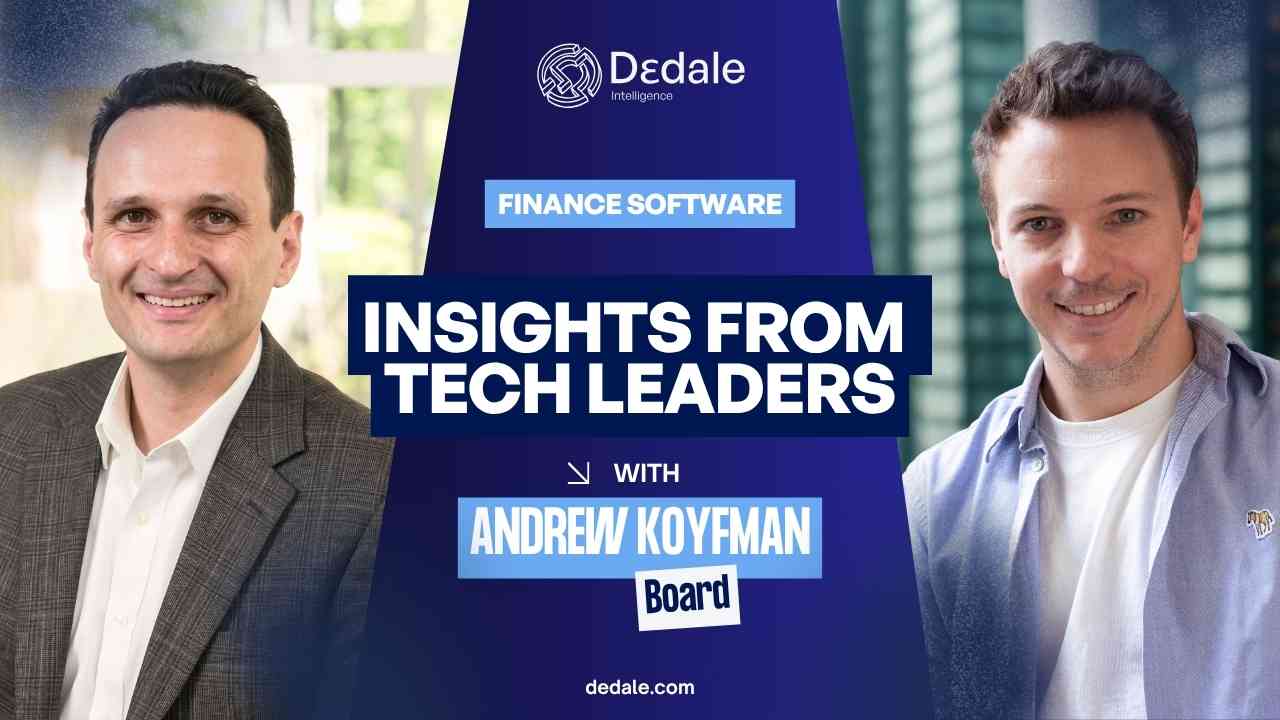
In this new episode of our Insights from Tech Leaders series, Mathieu Canler, Investment & Strategy Associate VP at Dedale, sits down with Andrew Koyfman, VP Strategy at Board International, to explore how enterprise planning software is evolving at the intersection of AI, financial consolidation, and cross-functional operations.
Board International has been building enterprise planning infrastructure for over 30 years. Founded in Lugano, the company has grown into a global platform recognized for FP&A, financial consolidation, and operational planning, serving large enterprises across retail, manufacturing, and financial services. Andrew joined two years ago to lead strategic growth initiatives, working closely with customers, partners, and go-to-market teams.
The conversation covers three main areas: what AI actually changes for finance teams today, how Board is embedding it into the platform, and what the journey of taking a European-born vendor into the US market really looks like from the inside.
🎥 Watch the full interview
🎧 Listen to the podcast
Board's core proposition is straightforward: connect financial and operational decision-making in one environment. Where many EPM vendors remain focused on FP&A and consolidation, Board extends into operational planning processes, including retail planning, merchandising, supply planning, and S&OP. The idea is to bring finance teams and operational teams onto the same data layer, removing the fragmentation that comes with disconnected systems or spreadsheet-heavy workflows.
Andrew frames AI as the next evolution of that same journey, not a break from it. The EPM platform did the hard work first: aggregating data from siloed enterprise systems, creating a trusted source of record that finance teams could actually rely on. AI now sits on top of that foundation, automating analysis, recognising patterns, and generating insights proactively.
"AI is going to help finance teams spend more time thinking about the business and interpreting outcomes, and less time gathering data, reconciling figures, and doing entry-level analyses."
The key constraint he identifies is context. AI cannot function at enterprise scale without understanding the full business: what revenue is, what units are, which regions the company sells in, how the planning model is structured. That context lives inside the EPM platform. Trying to deploy an external AI agent on top of raw enterprise data is technically possible but practically costly and incomplete.
"The only way AI can get that full context is by using a system that already has it built in. That is essentially what an EPM platform does."
Governance, Auditability, and the Human in the Loop
One of the more grounded sections of the conversation covers AI governance, a topic that finance leaders raise consistently and that Andrew approaches with notable pragmatism. The answer to "how do you trust an AI-generated forecast?" is not architectural complexity. It is traceability and a person who has actually reviewed the output.
Board has built agents trained to function as analysts: FP&A analysts, planning analysts, merchandising analysts. These agents record their reasoning, the inputs they used, and the execution steps they followed. That audit trail is what allows a finance team to go to the board with an AI-assisted analysis and say, credibly, that they have validated the assumptions and the inputs.
"Everybody knows that letting AI run without validation is a recipe for disaster. The board feels comfortable when there is a person in the middle who has actually reviewed the output."
Andrew is direct about where AI currently fails: when people treat it as a replacement for thinking rather than a tool that accelerates it. The companies that will use AI well are the ones that understand it requires equally rigorous process and change management on the human side.
Customer Adoption: Still in the Experimental Phase
On adoption, Andrew's view is consistent with what most EPM and planning vendors are observing: interest is high, production use is low. He estimates that fewer than 5 to 10% of customers have adopted AI features at scale, with the remainder still in POC or testing phases.
Finance organizations are naturally conservative. When selling Board today, AI roadmap questions are common, but they rarely drive purchasing decisions, at least in retail and manufacturing, which are Board's core verticals. Customers want to know that a credible path exists. They are not yet ready to walk it.
The more compelling near-term driver Andrew identifies is continuous planning. The speed at which macroeconomic conditions, supply chains, and demand signals shift has made quarterly or even monthly planning cycles structurally inadequate. AI's value here is not in replacing the planner, but in making the planning loop fast enough to be genuinely useful.
"The world is changing too quickly to plan once a quarter. You need to do it on a daily or weekly basis, and you cannot do that without automation."
Pricing in Transition: From Users to Consumption
The monetisation question around AI is one the whole SaaS industry is working through in real time. Andrew's framing is clear: the traditional user-based pricing model is under pressure from two directions simultaneously. AI makes each user more productive, which reduces headcount in finance functions that are already viewed as cost centres. At the same time, the remaining users will consume the system much more intensively.
The logical response is a shift toward consumption-based pricing, tied to tokens or CPU cycles rather than seats. Board has already started moving in this direction for AI-specific features. The broader transition will be gradual, and Andrew is careful to note that existing commercial models are not disappearing overnight.
"The AI part of the price will increasingly be tied to consumption. But that is a long-term evolution, not an overnight change."
The US Expansion: Harder Than Expected
Board's US expansion is one of the more candid parts of the interview. The rationale was straightforward: the US is the largest software market, and Board had built a strong European base that few EPM vendors could match. When Nordic Capital acquired the company roughly five or six years ago, expanding into North America was a core investment thesis.
The execution has been harder than anticipated. Andrew identifies two main friction points: building a partner ecosystem from scratch and building brand recognition in a market where Board is not yet a default name on the shortlist. In Europe, Board had a deep network of implementation and sales partners who could bring the product into accounts, advise CFOs, and handle significant portions of the deployment work. In the US, that network had to be built from the ground up, and it takes time.
The brand challenge is compounded by geography. Customer references that would be routine in Europe become logistical exercises when the reference is in Germany and the prospect is in California.
"Going from zero to significant business is a lot harder than we expected. It turns out it is not the software or the company itself, it is the entire ecosystem around it."
The structural response has been to localise the management team. Board now has a US-based leadership team that brings direct market knowledge and existing relationships to the sales process. Combined with a strengthened partner network, Andrew sees the momentum building, though he is measured about timelines.
On the question of whether the US buyer is different, his view is nuanced. The underlying problems that CFOs are trying to solve are broadly similar across geographies: forecast accuracy, agility, reduced manual processes. The cultural differences are real, particularly around decision-making speed and the pace at which the US market moves, but they are not so fundamental as to require a different product or commercial model.
Beyond AI: Unified Planning Across the Organisation
When asked about the next major shift in enterprise planning, Andrew points to something Board is already building toward: the extension of planning beyond the finance function. The premise is that finance teams sit on data and decision-making processes that are deeply intertwined with operations, merchandising, and supply chain, yet these functions often operate in separate systems with separate planning cycles.
Bringing these teams onto the same data foundation, so that supply chain planners and finance analysts are working with the same figures and making decisions in concert, is the structural change Andrew sees reshaping how enterprises operate. For Board, this is not a disruption to navigate. It is the direction the platform is heading.
For vendors whose positioning is narrowly defined as finance software, however, this convergence creates real exposure.
One Piece of Advice for CFOs
Andrew closes with a point that cuts across both the AI discussion and the broader change management challenge. Technology is a genuine enabler of faster, more efficient organisations. But the companies that succeed with it are not the ones that implement the most sophisticated tools. They are the ones that invest equally in helping their teams adopt new ways of working.
"Without people, even with AI, it is just not going to work. The process transformation and the people transformation matter as much as the technology itself."
He draws directly on Board's own experience: over 20 years of implementations have produced plenty of cases where the technology was deployed well but the organisation did not change its practices to actually use it. That accumulated knowledge of what goes wrong is, he argues, a competitive advantage that newer entrants simply cannot replicate.
This interview is part of our Insights from Tech Leaders series, where Dedale Intelligence sits down with senior executives and investors across the global technology landscape to explore the trends shaping software markets.
About Board International
Board International is a leading enterprise planning platform helping organisations align financial and operational decision-making in a single environment. Recognised for FP&A, financial consolidation, and operational planning, Board serves enterprise-level organisations across retail, manufacturing, and financial services.For more information, visit: www.board.com

Explore our resources

AI, Grid Inspection & the AI-Ready Utility with Vikhyat Chaudhry (Buzz Solutions)

Frequently asked questions
Enterprise Planning and AI in Finance: Common Questions
Answers to the most common questions from Dedale's interview with Andrew Koyfman, VP Strategy at Board International.
What does Board International's platform cover?
Board connects financial and operational decision-making in one environment, extending beyond FP&A and consolidation into operational planning processes like retail planning, merchandising, supply planning, and S&OP.
How does Andrew Koyfman see AI changing finance teams?
AI is expected to help finance teams spend more time thinking about the business and interpreting outcomes, and less time gathering data, reconciling figures, and doing entry-level analysis.
Why does AI need an EPM platform to work at enterprise scale?
AI cannot function at enterprise scale without full business context, such as what revenue means, what units are, and how the planning model is structured. That context already lives inside the EPM platform, which is why deploying an external AI agent on raw enterprise data is costly and incomplete by comparison.
Newsletter
Fresh insights, straight to your inbox
Trusted by 2,000+ clients
Get started
Investor, operator, or industry expert, there's a path for you.