The SaaSPocalypse & What Comes Next with Vladimir Lasocki (Carlyle)
Vladimir Lasocki, Managing Director at Carlyle, reflects on 26 years at the frontier of European technology investing, from the dot-com crash to the SaaSPocalypse, and explains why discipline is the only edge that compounds.
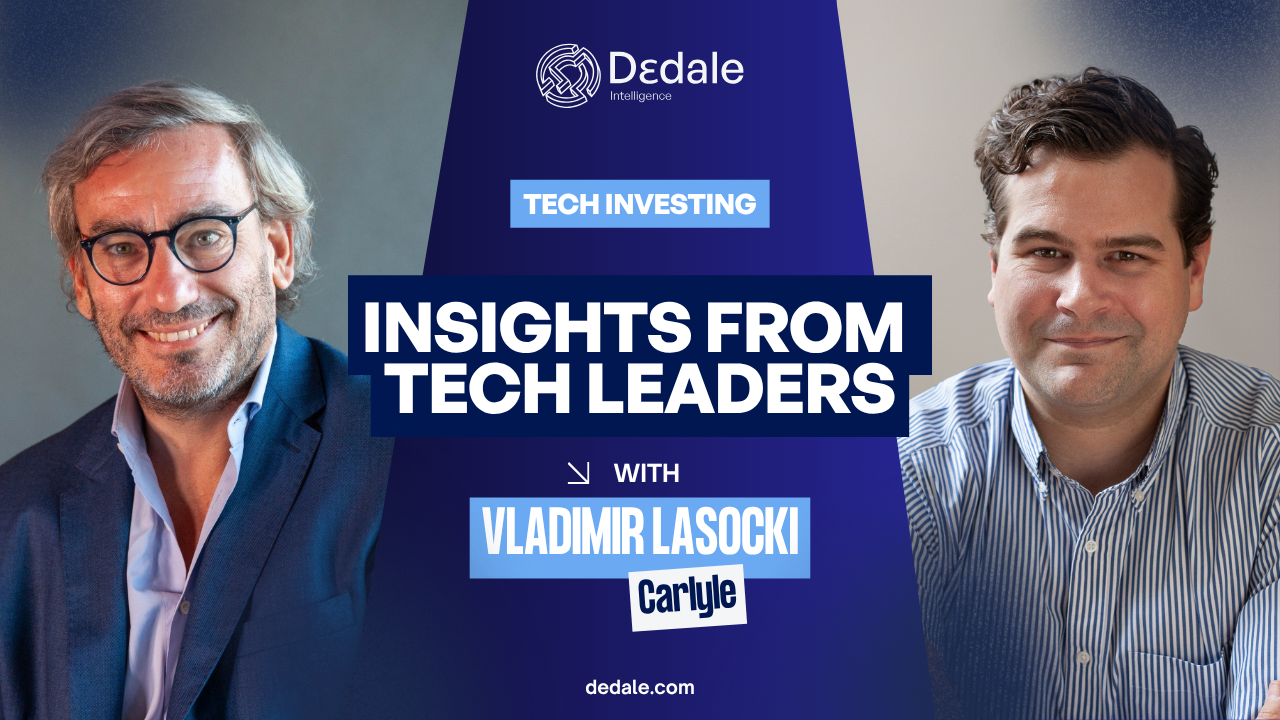
Discipline, Cycles, and the SaaSPocalypse: A Long View on European Tech Investing
In this new episode of our Insights from Tech Leaders series, Benjamin Forlani, Founder & CEO of Dedale Intelligence, sits down with Vladimir Lasocki, Managing Director at Carlyle, to explore what 26 years at the frontier of European technology investing really looks like. The conversation spans the dot-com crash, the SaaS boom, the 2022 correction, and the AI moment we're living through now.
Vladimir built Carlyle Europe Technology Partners from the ground up since 1999, growing it into a ~€6 billion platform spanning hardware, software, and technology services across Europe, with 76 investments and consistent exits since 2002. This conversation is a rare opportunity to hear a genuine long-term perspective on how the craft of tech investing has evolved, what has stayed constant, and why discipline is the only edge that compounds.
🎥 Watch the full interview
🎧 Listen to the podcast
26 Years, One Strategy: Why Carlyle Europe Technology Partners Stayed Small-Cap
Vladimir's entry into technology investing was shaped by the worst possible moment to start: late 1999, at the peak of the dot-com bubble. When the crash came, Carlyle's European venture fund had capital to deploy into a market where technology had become, as Vladimir puts it, "radioactive."
That context defined everything. The strategy that emerged was small-cap buyouts across hardware, software, and tech services, pan-European, founder-led primary situations. It was not designed in a boardroom. It was the product of what Vladimir describes as "a fairly Darwinian process," finding what worked when no one else wanted to be in the room.
Today, Carlyle Europe Technology Partners manages approximately €6 billion across 76 investments. Software represents around 45% of the portfolio, with hardware and tech services making up the remainder. The geographic scope is genuinely pan-European, with Central and Eastern Europe now accounting for around 30% of deals done in the last four years.
"In 2002, you had the plague when you were doing technology. You were hiding from everyone else. Which actually brought us together with entrepreneurs."
The decision to stay small-cap was, by Vladimir's own account, partly constrained: at Carlyle, the larger European fund and the US operations already covered adjacent territory. But it also reflects a genuine conviction that the European technology opportunity set is structurally a lower mid-market story. With no equivalent of California to produce scale-out software companies at volume, the returns available in Europe are concentrated in founder-led primary situations, not in replicating the US playbook.
Europe Has Technology But Doesn't Have California
The single most important structural observation in Vladimir's view of European tech is geographic. Europe produces excellent technology in medical devices, industrial automation, regulated software, and increasingly in cyber and AI-adjacent infrastructure. It does not, however, produce the concentrated domestic markets that allow US software companies to reach multi-billion dollar scale before they ever need to go international.
This shapes everything about how Carlyle invests. Software is only 45% of the portfolio because tech-enabled services and hardware offer genuine growth and value opportunities in Europe that a purely software-focused strategy would miss. It explains why the fund goes to Brno, Segovia, and Aarhus rather than waiting for deals in London or Paris. And it explains why almost two-thirds of exits over the years have been to US trade buyers. The natural end-game for a European champion is acquisition by an American platform looking for European market access or a complementary product.
Recurring vs. Perpetual: How Software Valuations Got Distorted
The central analytical contribution of this conversation is Vladimir's distinction between recurring and perpetual revenue, and his account of how investors lost the ability to tell them apart.
Before SaaS, software was sold through perpetual licenses with large upfront payments, heavy professional services tails, and no guarantee of renewal. Revenues were lumpy, margins were complex, and investor interest was limited. When SaaS emerged and subscription revenue became the norm, investors recognised something genuinely valuable: a business where revenue recurs, where churn is visible, where the model is predictable.
What followed, in Vladimir's telling, was a category error at scale. Investors began treating recurring as synonymous with perpetual, as if a software subscription, once signed, would renew indefinitely regardless of product quality, competitive pressure, or customer value. Valuations expanded accordingly, from 6x EBITDA when Vladimir started to 30x and beyond at the peak.
"I confused recurring with perpetual. And I wasn't alone. The whole industry did."
The SaaSPocalypse is Vladimir's term for the 2022 to 2024 correction. In his reading, it was less a story about what AI does to software businesses than a story about what happens when investor psychology corrects from a decade of category error. The businesses themselves, the good ones at least, are largely unchanged. What corrected was the valuation discipline that should never have been abandoned.
What Discipline Actually Means in Private Equity
Vladimir returns to the word "discipline" repeatedly across the conversation, and it is worth unpacking what he means by it. It is not conservatism or risk aversion. It is the practice of pricing imperfection honestly: identifying the real risks in a business and reflecting them in both the value creation plan and the entry terms, rather than assuming they will resolve themselves once the deal closes.
Carlyle Europe Technology Partners has exited investments every year since 2002, including through the dot-com aftermath, the 2008 financial crisis, and the 2022 SaaS correction. Across 51 realised investments, the average return is 3x. Vladimir's explanation for the consistency is not that the team has been lucky or that every deal was a winner. It is that pricing discipline, maintained through cycles, produces better average outcomes than concentrated bets on the upside.
"If a business is imperfect, it can still be a great investment opportunity. But you need to reflect it in your value creation plan and the terms at which you invest. That's the discipline that matters."
How AI Is Changing the Investment Lens
Vladimir is candid about the limits of his knowledge when it comes to AI. After 26 years across hardware, software, and services, there is simply too much change to absorb completely, and he says so directly. His response is not to pretend expertise he does not have, but to rely on the entrepreneurs and CEOs in the portfolio who are living the transition up close.
Where he does have a view is on the investor side. The AI conversation, in his experience, currently generates more noise than signal at the fund level. Every CEO in the portfolio has had their briefing with Anthropic and OpenAI. Every board is asking the same questions. The companies that will navigate AI well are, in his reading, the ones that start from genuine business problems their customers need solved, not from the technology itself.
On the investment side, the filters are evolving. Carlyle is looking more closely at AI-first businesses, though with caution about distinguishing real signal from hype. Non-conventional tech, including industrial automation, space, and live events infrastructure, is generating heat. Cyber remains a structural growth area. And peripheral Europe, particularly Spain, Italy, and Central and Eastern Europe, is increasingly productive.
"Think of it as a heat map. The heat for us right now is in non-conventional tech, in certain areas of software, in cyber, and in peripheral Europe."
Tech-Enabled Services: Every Old Deal Is a New Deal
One of the most practically useful observations in the conversation concerns services businesses. Vladimir's portfolio includes a number of technology-enabled services companies: cyber services, data and AI services, and implementation and consulting businesses. His read on how AI changes them is counterintuitive.
Rather than treating AI as a threat to services revenue, Vladimir sees it as a demand generator. Cyber services businesses in the portfolio are receiving more demand, not less, as the attack surface expands and the skills gap widens. Data and AI services businesses are growing as enterprises need help implementing what they have been sold. Implementation consulting is evolving: the configuration work will compress, but the business transformation layer will expand.
The heuristic he applies is simple: before he evaluates whether AI creates a new opportunity in a services market, he first asks whether the companies he already owns are applying AI to their own operations. If the answer is no, the opportunity thesis is not credible.
"Every old service deal is a new deal in services. The question is whether the people running those businesses are willing to make it one."
This interview is part of our Insights from Tech Leaders series, where Dedale Intelligence sits down with senior executives and investors across the global technology landscape to explore the trends shaping software markets.
About Carlyle Europe Technology Partners
Carlyle Europe Technology Partners (CTP) is Carlyle's European technology investment platform, managing approximately €6 billion across hardware, software, and technology services. Founded in 1999, CTP focuses on small and mid-cap buyouts of founder-led technology companies across Europe, with 76 investments and consistent exits since 2002. For more information, visit: www.carlyle.com
Explore our resources


Frequently asked questions
European Tech Investing: Questions from the Community
Vladimir Lasocki, Managing Director at Carlyle Europe Technology Partners, has spent 26 years investing in technology across Europe. Below are answers to the most common questions about European PE investing, software valuations, and the SaaSPocalypse — drawn directly from his interview with Dedale Intelligence.
What is the SaaSPocalypse and what caused it?
The SaaSPocalypse is Vladimir Lasocki's term for the 2022 to 2024 correction in software valuations. In his view, it was not primarily caused by AI disrupting software businesses. It was caused by a decade of investors confusing recurring revenue with perpetual revenue. When SaaS subscription models became mainstream, investors treated software revenues as if they would renew indefinitely regardless of product quality or competitive pressure, pushing valuations from 6x EBITDA to 30x and beyond at the peak. When interest rates rose and growth decelerated, that assumption collapsed. The underlying businesses, the good ones at least, were largely unchanged. What corrected was investor psychology, not the software industry itself.
Why does Carlyle Europe Technology Partners focus on small-cap buyouts rather than scaling up?
Carlyle Europe Technology Partners manages approximately €6 billion across hardware, software, and tech services, focusing on small-cap buyouts in the €200 to €600 million enterprise value range. Vladimir Lasocki explains that this is partly a constrained choice: within Carlyle, a larger European fund and the US operations already cover adjacent territory. But it also reflects a genuine strategic conviction. Europe does not have a California: there is no concentrated domestic market producing scale-out software companies at volume. The opportunity set that allows investors to deploy very large amounts of capital purely in European tech private equity is structurally limited. Staying small-cap means more impact per deal, better returns, and a strategy that is genuinely suited to the European technology landscape rather than imported from the US.
What is the difference between recurring and perpetual revenue in software?
Recurring revenue means a customer pays on a subscription basis and can choose not to renew. Perpetual revenue would mean a customer pays and continues paying indefinitely, regardless of satisfaction or competitive alternatives. Vladimir Lasocki argues that the software investment community spent a decade treating SaaS subscription revenue as if it were perpetual, assuming renewals were guaranteed and pricing companies accordingly. This drove valuations to levels that could only be sustained if churn were zero and competitive pressure non-existent. The distinction matters enormously for valuation: a truly recurring business where retention is earned every year is worth far less than a perpetual annuity, and investors who forgot that paid for it in the 2022 to 2024 correction.
How is Carlyle approaching AI in its European tech investment strategy?
Vladimir Lasocki is candid that no one, including experienced investors, fully understands where AI will land across software categories. His approach is to follow the heat rather than the hype. Carlyle Europe Technology Partners is looking more closely at AI-first businesses, but with discipline around distinguishing real signal from noise. Non-conventional tech, including industrial automation, space, and live events infrastructure, is generating genuine interest. Cyber remains a structural growth area as the attack surface expands. Peripheral Europe, particularly Spain, Italy, and Central and Eastern Europe, is increasingly productive. On the services side, Vladimir sees AI as a demand generator rather than a threat: cyber services and data and AI services businesses in the portfolio are receiving more demand, not less, as enterprises need help implementing and operating AI-enabled systems.
What has made Carlyle Europe Technology Partners consistently exit investments across every market cycle since 2002?
Across 51 realised investments, Carlyle Europe Technology Partners has achieved an average return of 3x and has exited investments every year since 2002, through the dot-com aftermath, the 2008 financial crisis, and the 2022 SaaS correction. Vladimir Lasocki attributes this to pricing discipline: the practice of identifying the real risks in a business and reflecting them honestly in both the value creation plan and the entry terms, rather than assuming problems will resolve themselves post-close. In his words, an imperfect business can still be a great investment opportunity, but only if the imperfection is priced in. This discipline, maintained consistently through market cycles, produces better average outcomes than concentrated bets on upside scenarios.
Newsletter
Fresh insights, straight to your inbox
Trusted by 2,000+ clients
Get started
Investor, operator, or industry expert, there's a path for you.