AI in GovTech: A Low-Disruption Market Where Incumbents Hold the Advantage
Dedale's AI in GovTech report covers AI adoption across 205 local authorities in the US, UK, and France, disruption risk by pillar, vendor benchmarking, and the barriers holding the market back.

GovTech is not a market where AI is going to arrive and reset the competitive landscape overnight. The switching costs are too high, the replacement cycles too long, and the regulatory requirements too specific. What AI is doing instead is concentrating its value in back-office administration and citizen-facing workflows, embedding inside incumbent platforms, and creating a narrow but real opening for challengers in the lowest-stickiness categories.
Dedale's AI in GovTech report is built on 60 primary expert interviews with industry experts across vendors and customers in the US, UK, and France, combined with survey data from 205 local authorities. This article draws selectively on the key findings. The full analysis, including the complete AI use case deep-dives by pillar, vendor benchmarking across five dimensions, and the full survey datasets, is in the report.
For broader context on the US public sector software market, see Dedale's Understanding the US B2G Software Market article. For a structural overview of the AI value chain, see the Artificial Intelligence Strategic Overview report.
GovTech: five pillars, very different AI risk profiles
Local government responsibilities cluster into five functional pillars: Public Administration and Civil Services, Community Services, Infrastructure and Public Works, Education and Culture, and Public Safety. Each carries a fundamentally different AI disruption risk profile, shaped by switching costs, data complexity, regulatory constraints, and customer readiness.
Public Administration and Civil Services is where AI ROI is most accessible. The workflows are document-heavy, high-volume, and largely text-based: document reading and OCR, minutes summarization, FOIA request triage and redaction, benefits eligibility determination, and fraud and anomaly detection. Switching costs vary by function, highest in ERP and lower in citizen-facing tools, which is precisely why AI lands differently across the same pillar.
Community Services carries very high ROI from AI, particularly in finance operations, records automation, document processing, and benefits triage and eligibility screening. The structured, high-volume, repetitive workflows in areas like accounts payable, general ledger, and records management are among the most automatable in the entire local government estate. Very high switching costs and decade-plus replacement cycles mean AI enhances the incumbent rather than displacing it.
Infrastructure and Public Works sits in the middle: moderate ROI from use cases like predictive maintenance, permitting intake, route optimization, and inspection triage, but moderate-to-high stickiness rooted in GIS lock-in (dominated by Esri) and asset data history. Customer readiness is low, with field-based, spreadsheet-heavy, and on-premise GIS deployments dominating.
Education and Culture shows low to moderate AI ROI, with use cases mainly from general-purpose tooling: timetabling, alerts, archive digitization, video redaction. No distinct education-specific AI category has emerged.
Public Safety is the most structurally protected pillar. CJIS compliance, evidentiary standards, and mission-criticality keep automation appetite very low. AI use cases such as incident transcription, report drafting, and evidence redaction are present but limited. Extreme stickiness and very high switching costs make this the hardest pillar for any AI-native entrant to penetrate.
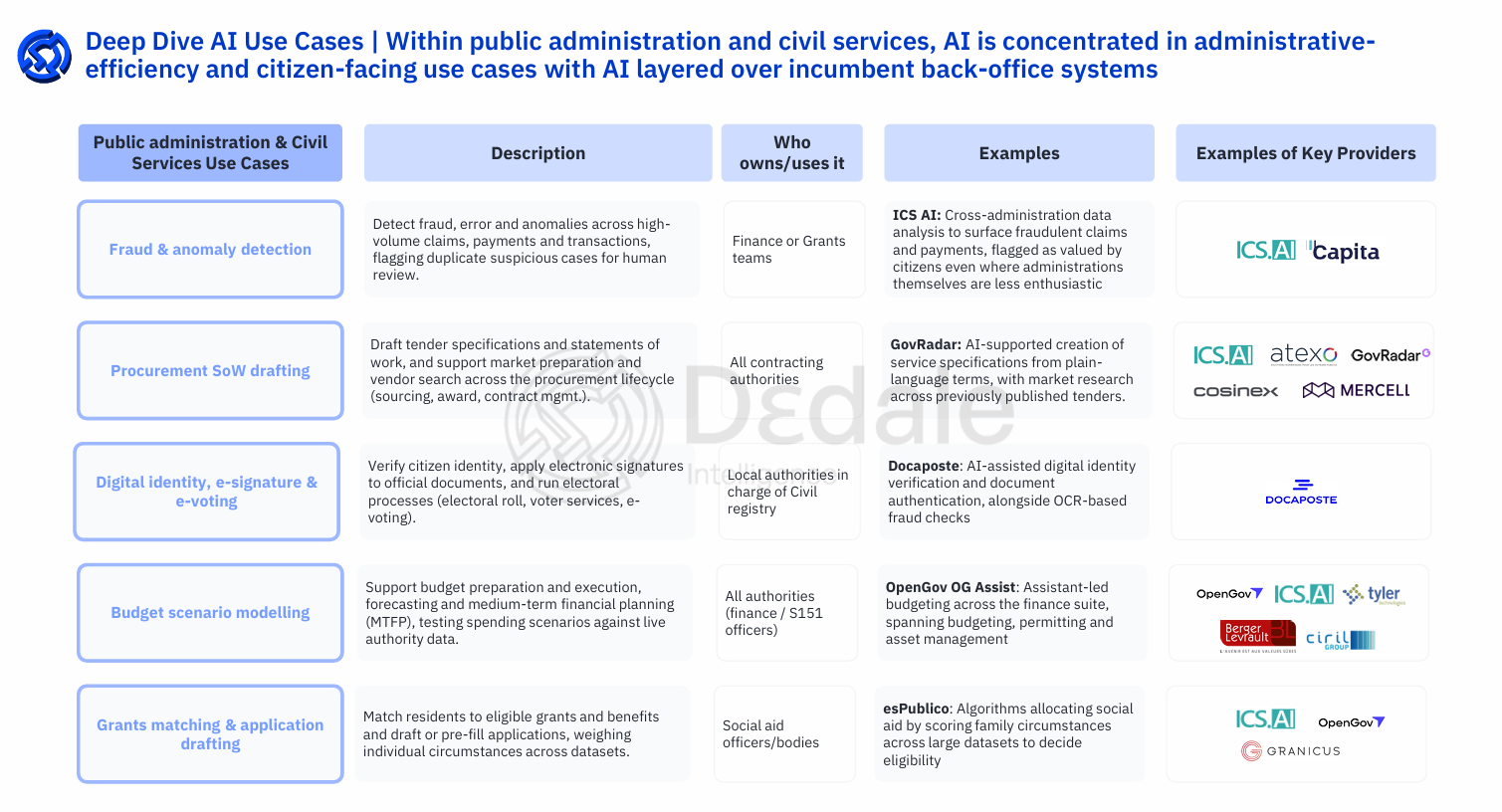
Where AI actually lands: the use case picture
Across all five pillars, two AI use cases are universal. Document generation and summarization is the top priority in every survey market and every authority size, placed in the top five by 79% of small US authorities, 71% of medium, and 92% of large. Citizen chatbots and virtual assistants are the consistent second-ranked use case across the US, UK, and France alike.
Below those two, a common layer of staff copilots, request triage and routing tools, and semantic document search serves every pillar. The high-disruption, standalone-capability use cases are the minority: fraud and anomaly detection, predictive maintenance, and image and video analytics cluster at the bottom across all markets.
The use case picture confirms the thesis: AI improves existing workflows rather than replacing the platforms that run them. It is additive efficiency inside the incumbent's estate, not a platform displacement event.
The survey: 205 authorities, three markets, one consistent story
Dedale surveyed 100 US authorities, 50 UK local authorities, and 55 French authorities. The findings are remarkably consistent across geographies.
Around 86% of US authorities run AI on under a fifth of their workloads. The UK picture is almost identical, with County councils at 90% in the under-20% band. France follows the same pattern, with the majority of authorities in the developing or piloting stage and only 6 of 55 (approximately 11%) describing themselves as already deploying AI in production.
The barriers are internal to local authorities, not a product problem. In the US, budget constraints (58 mentions), staff skills and capacity (57), public or political trust concerns (48), data residency and security compliance (44), and risk aversion (40) all rank above vendor AI capability gaps (22). In the UK the order is almost identical. In France, data residency and GDPR security lead at 58% (32 of 55), budget at 56% (31), and staff skills at 51% (28), though vendor capability gaps in France are notably higher at 49% (27), meaning nearly half still see the product itself as a partial barrier.
Budget intent is real. Roughly four in five US authorities plan to allocate some IT budget to AI over the next two to three years. In the US, 58% of large authorities (500,000 or more residents) expect to spend over $250,000 on AI. In the UK, 28% of authorities expect to spend over £250,000 and a further 26% between £100,000 and £250,000. In France, a majority plan more than €100,000, with 31% of large authorities and departments planning above €250,000.
The critical pricing dynamic: authorities expect to pay through their incumbent contract. In the UK, 80% want AI included in their existing subscription at no extra cost or as a percentage uplift. France is more open at 27% standalone appetite, but still majority-bundled at 58%. The conclusion is the same in every market: incumbents can attach AI to an existing subscription and capture the budget defensively, while AI-native challengers face a structural pricing headwind regardless of product quality.
In the US, perceived AI leadership splits between govtech specialists and Big Tech. OpenGov leads at 55% of mentions, with Microsoft close behind at 54% and Salesforce at 33%, ahead of Tyler at 20%. In France, Microsoft leads at 75% of respondents naming the company as an AI leader in local government.
Download the full AI in GovTech report
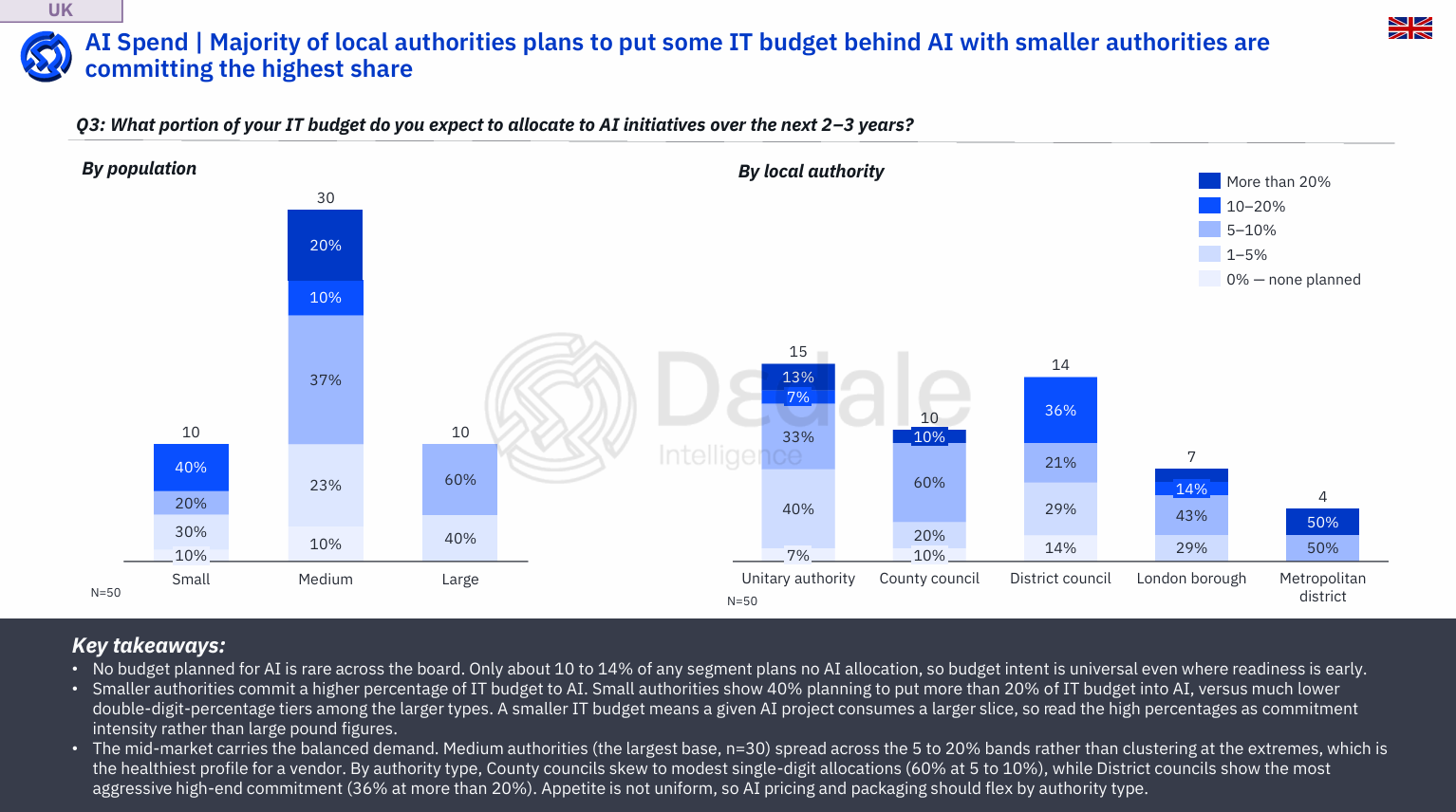
Openness to challengers: real but selective
Openness to an AI-native challenger is real but concentrated in the lowest-stickiness categories. In the US, community engagement software leads at 44% of authorities willing to consider a challenger, followed by asset management at 32% and community development at 31%. Public safety and court systems sit at the bottom: law enforcement at 19%, emergency management at 9%, and justice and court management at 8%. Only 21 of 100 US authorities say they would stay with incumbents across all categories, meaning roughly four in five are open to a challenger in at least one area.
In the UK, citizen self-service applications lead openness to AI-native alternatives at 19 mentions out of 136, followed by asset management, procurement, and HR and payroll at 11 each. County councils are the most defensive, District councils the most open.
In France, citizen relationship and territorial CRM leads openness at 27% (15 of 55), followed by HR and financial management at 22% each, and procurement at 18%. Regulated and mission-critical verticals sit at the floor: civil registry, elections, municipal police, and social care all at 4% or below.
The pattern is consistent: AI raises interest but does not by itself overcome switching cost in the sticky statutory estates. The opening is real, but it is narrow and concentrated.
Vendor benchmarking: challengers lead capability, incumbents lead reach
Dedale assessed vendors across five dimensions: AI infrastructure readiness, talent and organizational capabilities, data sources integration, deployment in production, and AI explainability and governance.
In the US, OpenGov leads on cloud-native build and AI deployment, scoring 7.2 overall. The company is fully cloud on AWS and Azure with a modern stack, carries approximately 300 engineers with around 10 on a core AI team, and has shipped OG Assist as a live copilot to almost its whole base of approximately 1,900 agencies, with around half actively using it. Tyler Technologies scores 7.0 overall as the largest US govtech player, with the deepest public-sector data estate spanning decades of court, tax, and public-safety records, but AI is under 5% of its approximately $2bn revenue and 20 to 25% of its customer base has not yet completed cloud migration, which caps near-term AI deployment. Accela and CivicPlus both score 6.7, with Accela's in-house AI still limited to spell-checking and natural-language query in production, and CivicPlus managing AI through partnerships and acquisitions with approximately 30% adoption of its chatbot product among its installed base.
In the UK, the AI-native challengers BEAM and ICS.AI lead on deployment. BEAM scores 7.0, with its AI scribe used by around 70% of UK local authorities in its category, generating statutory-format case notes directly from transcribed social care and housing meetings. ICS.AI scores 6.8, with a digital assistant live across approximately 30 to 35 councils (approximately 65% of its target segment) and deflecting approximately 55% of contact-center calls. Civica scores 6.0 and Capita scores 5.5, both working through technical debt and with AI still early in their suites.
In France, Berger-Levrault leads the whole panel on sovereign, own-built AI and governance with a score of 7.4. The company has a large internal research and innovation team with INRIA and CNRS partnerships, approximately 25% of revenue in R&D, a proprietary legal database tied to Légifrance that acts as a genuine data moat, and AI assistants in WeMagnus and Légibase adopted by over 50% of existing users within the first weeks of launch. Docaposte scores 6.5, built around an internalised Mistral model on French data centers, with live deployments in social security fraud scoring, mail reading, identity verification, and electronic signature. Nexpublica scores 5.5, gated by an incomplete cloud transition and an AI capability acquired through the Wikit acquisition that is only now being integrated.
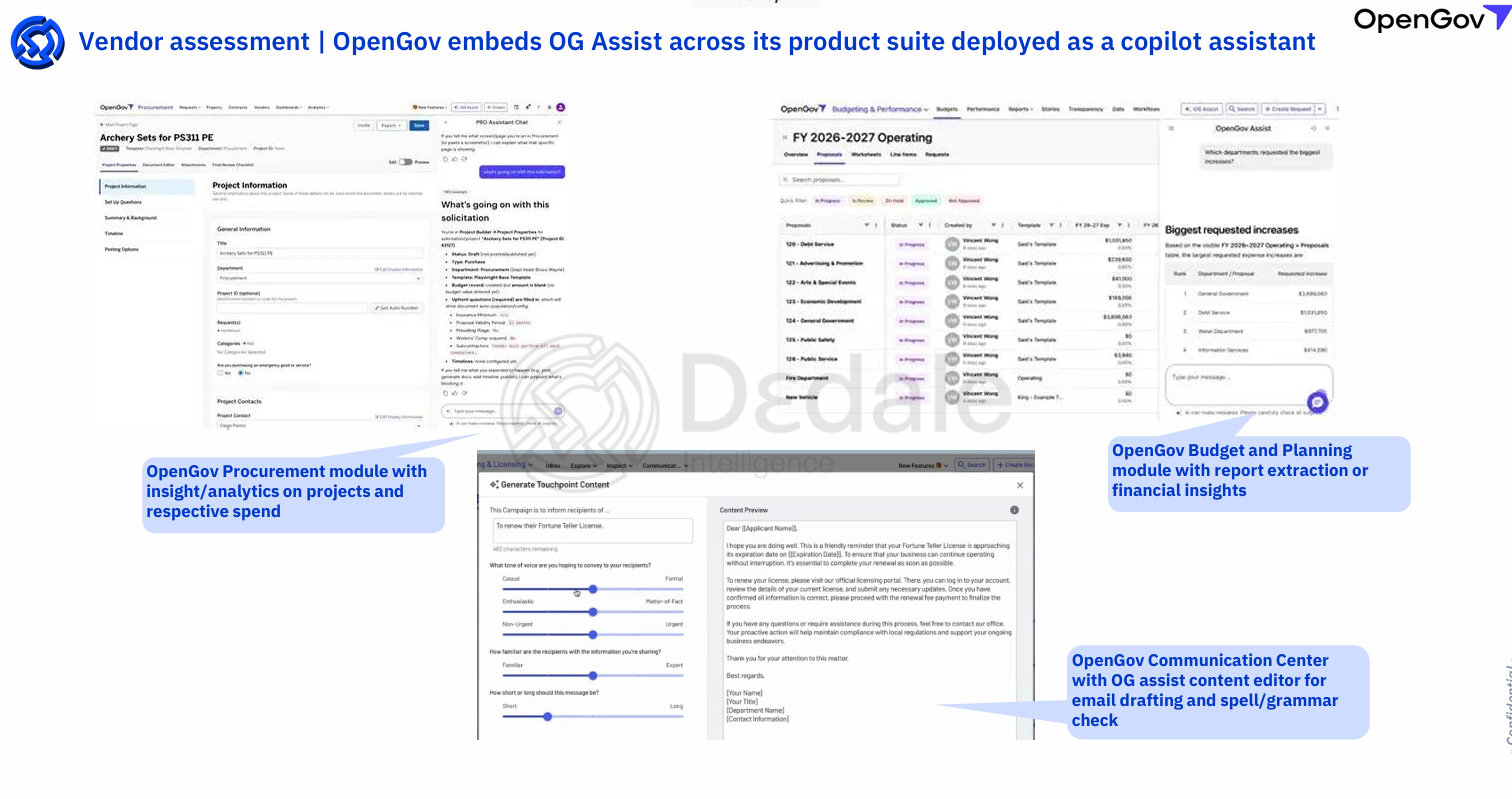
How Dedale researches the GovTech market
Dedale's AI in GovTech report is built on 60 primary expert interviews with vendors, alumni, and channel partners across the US, UK, and France, combined with survey data from 205 local authorities across the three markets. The report covers the GovTech framework and market structure across five functional pillars and three geographies, a full AI use case map across each pillar, the complete survey findings on AI readiness, spend intent, pricing preferences, and use case priorities by market and authority size, a vendor-by-vendor AI benchmarking assessment across the US, UK, and French competitive sets, and a disruption matrix mapping AI risk across the full local government software estate.
Download the full AI in GovTech report now!
To discuss how this analysis can support a GovTech investment thesis, a go-to-market strategy, or an assessment of AI disruption risk across the local government software landscape, Contact the Dedale team!
Explore our resources
.jpg)
The Operating System for Indices: How PANTA Is Modernizing the Index Industry | Tobias Sproehnle, PANTA
.jpg)
Frequently Asked Questions
What is GovTech software and why does AI adoption lag other sectors?
GovTech software refers to technology platforms built specifically for local government functions, spanning public administration, community services, infrastructure management, education, and public safety. AI adoption lags other enterprise software categories because the blockers are internal to local authorities rather than product-related. Across Dedale's survey of 205 local authorities in the US, UK, and France, budget constraints, staff skills and capacity, data governance requirements, and public trust concerns consistently rank above vendor AI capability gaps as the primary barriers. Around 86% of US authorities run AI on under a fifth of their workloads. The pattern holds across all three markets.
Which GovTech categories are most and least exposed to AI disruption?
Disruption risk is uneven across the five functional pillars. Public Administration and Civil Services carries the highest AI ROI, concentrated in document-heavy, high-volume administrative workflows like OCR, records triage, minutes summarization, and benefits eligibility. Community Services follows closely, with finance operations, records automation, and document processing among the most automatable workloads in local government. Infrastructure and Public Works sits in the middle, with use cases in predictive maintenance and route optimization but low customer readiness. Public Safety is the most structurally protected pillar, held by CJIS compliance, evidentiary standards, and decade-plus replacement cycles. Dedale covers the full disruption matrix across the local government software estate in the complete report.
Who are the leading GovTech AI vendors in the US, UK, and France?
Perceived AI leadership varies by market. In the US, OpenGov leads at 55% of surveyed authorities naming it an AI leader, with Microsoft close behind at 54% and Salesforce at 33%, ahead of Tyler Technologies at 20%. In France, Microsoft leads at 75%. In vendor capability benchmarking, Dedale scores OpenGov at 7.2 overall in the US, BEAM at 7.0 and ICS.AI at 6.8 in the UK, and Berger-Levrault at 7.4 in France as the strongest AI builder in the French panel. The full benchmarking methodology and scores across five dimensions are covered in the report.
How do local authorities expect to pay for AI?
Authorities across all three markets expect AI to flow through their incumbent contract rather than as a separate purchase. In the UK, 80% want AI included in their existing subscription at no extra cost or as a percentage uplift, and only 14% would buy a standalone AI product. France is more open at 27% standalone appetite, but still majority-bundled at 58%. In the US, survey data shows that most authorities expect AI to be bundled with their existing platform subscriptions. This pricing dynamic is a structural headwind for AI-native challengers and a defensive advantage for incumbent vendors.
What is Dedale's methodology for the AI in GovTech report?
Dedale conducted 60 primary expert interviews with vendors, alumni, and channel partners across the US, UK, and France, combined with survey data from 205 local authorities across the three markets. The research covers AI readiness, spend intent, pricing preferences, use case priorities by market and authority size, a full AI use case map across five functional pillars, and a vendor-by-vendor AI benchmarking assessment scored across five dimensions: infrastructure readiness, talent and organizational capabilities, data sources integration, deployment in production, and AI explainability and governance.
Newsletter
Fresh insights, straight to your inbox
Trusted by 2,000+ clients
Get started
Investor, operator, or industry expert, there's a path for you.