Automating FP&A: How Cashboard Is Building the Solo CFO | Julian Rowlands, Cashboard
Julian Rowlands, founder and CEO of Cashboard, on why FP&A is really a data assembly job, how a data warehouse and semantic layer can automate it for the mid-market, and why LLMs like Claude are an unlock rather than a threat.
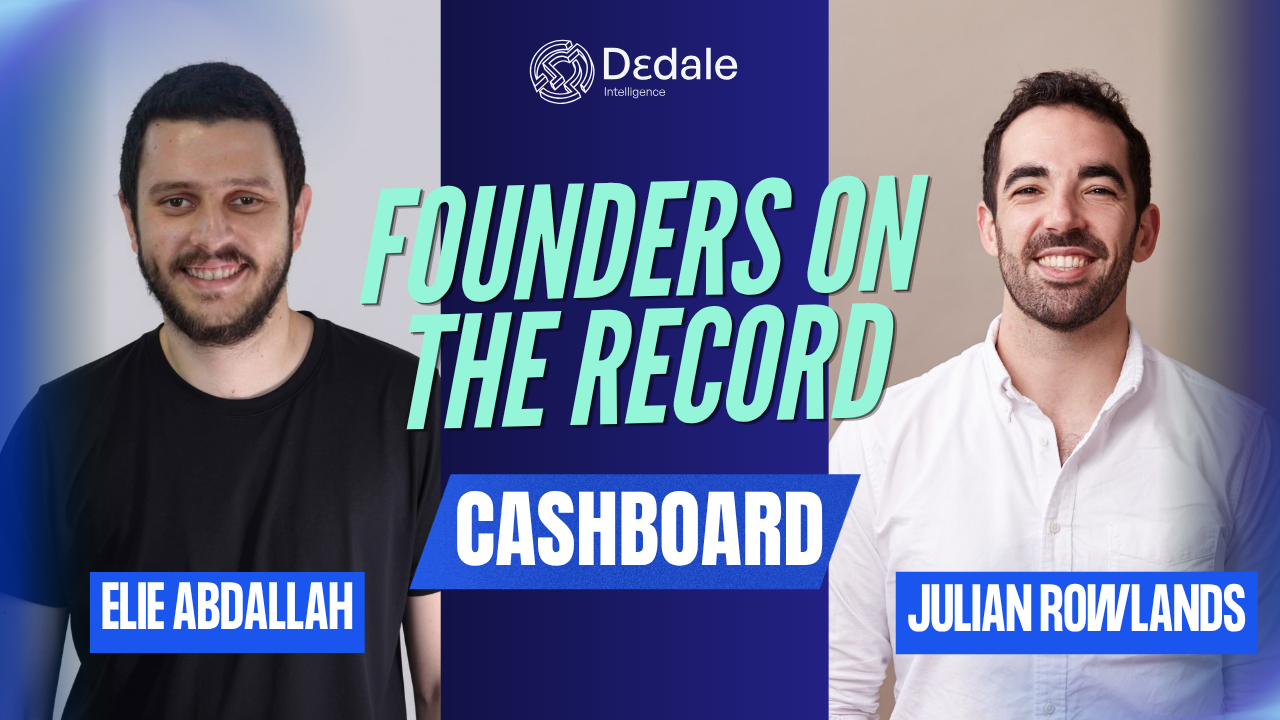
For most companies, financial planning and analysis is less about planning than about assembling data. Julian Rowlands, founder and CEO of Cashboard, lived that problem from the CFO seat and is now building software to remove it entirely.
In this Founders on the Record interview with Dedale Intelligence, Rowlands explains why FP&A is "close to a fake title" at most companies, how Cashboard combines a data warehouse and a semantic layer with more than 900 integrations, where AI should stop and human review should begin, and why he sees Claude and other LLMs as an unlock rather than a threat.
From the CFO seat to the vendor side
Before Cashboard, Rowlands was CFO at Xendit, which he describes as "the Stripe of Southeast Asia," joining right after its Series A. He then became head of finance at Spruce, an API for title insurance later acquired by Zillow Group, where the company grew from 70 to 400 employees during his two years there. Earlier, he did data systems consulting for hedge funds and went to business school at the University of Chicago.
The trigger was frustration. At Xendit, understanding cash balances took a week, because the company had multiple bank accounts and accounting systems that did not talk to each other. Every other question about the business took days as well, spent not on thinking but on getting data into a single source and matching labels to common definitions. Annual planning took three months, and Rowlands estimates "there are about two days worth of real thinking in those three months."
"Opportunities are found in intersections and overlaps," he says. As the only person he knew with both a data systems and a CFO background, he concluded that this work could be automated 100% with software plus AI.
Why FP&A is really a data assembly job
Rowlands sees the problem at "100% of companies that have not spent 10 years on a massive data engineering project," which is close to everyone. For those businesses, FP&A "is actually a data assembly function where only at the very end can you think about the business."
He splits a finance function into three groups: accountants, "the historians and scorekeepers"; financial operations, who move the money and make sure bills get paid; and FP&A, which predicts the future through budgets and forecasts and constantly analyzes the business using data from sales, marketing, HR, the CRM, accounting and internal KPIs. He frames FP&A as the navigators who keep the company safe.
A world-class FP&A team, in his definition, gets metrics to decision makers within a day of them being recorded, builds a new 12-month forecast every month within a couple of days, and completes annual operating planning within a week. "Almost nobody is actually at that world-class level," he says.
His startup CFO experience also shapes how he prioritizes. At a startup, "100 things are on fire and only one of them is actually going to help the business," and the job is to find that one thing, chase it relentlessly and let everything else burn.
A data warehouse, a semantic layer and 900+ integrations
Cashboard connects to every data source a company uses, including accounting systems, sales CRMs, internal data warehouses, payroll systems and spreadsheets, through more than 900 integrations that keep the data fresh. Everything is stored in a data warehouse with a semantic layer on top that holds metric definitions and data mappings, which Rowlands calls "the really hard part of finance because every system puts a different label on everything."
Cashboard does the implementation work and gets customers live in a couple of weeks. From there, teams can answer any question instantly and build forecasts in days rather than months, spending their time informing and driving the business "rather than running VLOOKUPs and crunching tables together."
The newest piece is an agentic budgeting product that lets teams run annual planning in one week instead of three months and reforecast in a day or two each month, with AI doing the heavy lifting and finance governing the process. Budgets built in the platform feed back into the same master data warehouse.
Cashboard also handles accounting consolidation. Companies running several accounting systems can pull them into one master general ledger with clean data labels that tie across systems, with one clean record for every vendor, customer and general ledger line, even across five different ERP systems.
Built for the complex mid-market
Cashboard targets mid-market American companies, typically with $10 million to $500 million in revenue. It is industry agnostic, with customers ranging from a charter school network to software companies, along with many private equity-backed businesses. The common thread is complexity: multiple data sources, or a business that is hard to budget.
The one requirement is clean data in the source systems. Startups are a poor fit, Rowlands says, because at $1 million a year "your numbers are totally broken everywhere" and "you also do not care about the numbers because you are too small." Mid-market companies, by contrast, have entire finance teams and good data, but spend their time assembling it, refreshing it and writing budgets into it.
Where AI stops and human review starts
"AI is great for suggesting things, but I never personally rely on it for the final answer," Rowlands says. He notes that no customer has ever reported a hallucination through Cashboard's MCP, which connects a customer's data to Claude. Even so, an AI-generated budget versus actuals analysis should still be reviewed by a human before it reaches anyone else.
Data mapping shows why. A new hire might appear under a full name in one system, as a first initial and surname in another, and simply as "new hire" in a fourth. Cashboard's mapping tool uses AI to surface unmapped labels and suggest mappings, but a human always accepts them. "If something gets moved to cost of goods sold when it should be in operating expenses, you have accidentally misrepresented your margins through data mapping," he says, adding that he knows CFOs who have almost been fired for that.
The staffing implication is significant: FP&A teams are moving toward being AI reviewers, which Rowlands believes means "fewer analysts and more directors" and more time for CFOs to focus on strategic work. For broader context, see Dedale Intelligence's analysis of how AI is transforming the Office of the CFO.
Why incumbent FP&A tools fall short
Rowlands keeps his critique broad rather than naming vendors. Many incumbents "have slapped AI on their websites" and added chatbots, but most FP&A tools were built as workflow tools for analysts to collaborate and are "fundamentally inflexible." They make it hard to get data in and to map things, typically helping only with general ledger account mapping between budgets and actuals, not with vendors.
Reporting is the second gap. Relying on archaic languages such as MDX, many of these tools outsource reporting to Microsoft Excel, so the platform never learns what a company likes to measure. The result, he says, is "an incomplete data dictionary" that prevents them from becoming a full source of truth for metrics.
The holy grail for finance teams, in his view, is a single data warehouse holding all historical data and detailed budgets, tied together by a semantic layer with every data label and metric. "We are that thing, and I am not aware of anyone else doing it."
MCP first: why LLMs are an unlock
Asked whether Claude, ChatGPT and other LLMs are a threat, Rowlands is clear that they unlock more. "Our entire product is MCP first, so anything you can do in the web app you can also do through MCP." Alongside built-in dashboards and an Excel plugin, Cashboard's semantic layer and data warehouse are available to Claude, ChatGPT, Google Gemini and Microsoft Copilot. He builds budget versus actuals reports on his phone while stuck on the subway, and users can trigger an entire annual planning cycle and fill in their budget forms from inside Claude.
Could a model provider build this itself? He would worry if one shipped a purpose-built data warehouse and API integration tool, because data imports need to be "deterministic rather than probabilistic." It would also need a semantic layer that tracks new labels as they flow in, plus workflow tools with deep security, audit trails, multiple reviewer loops and locking. He believes model providers are trying to be "the AWS of intelligence" rather than cannibalizing software. "We will find out the hard way."
Dedale has made a similar bet on open, governed data access for AI tools, with Dedale Intelligence now accessible via MCP.
The $5 million raise and the solo CFO
Cashboard raised $5 million a few weeks before the interview. The money went into hiring a principal backend engineer to complement the head of engineering, starting a sales team, and shipping agentic budgeting, "the last piece of the puzzle."
Cashboard V1 was what Rowlands calls a "controversial bet": go all in on the data platform for reporting and analysis, the part others had neglected. That made it "an FP&A platform that did not do any of the P at all." With planning now in place, he says Cashboard can "truly automate 99% of the FP&A work."
The product North Star is "inventing the solo CFO." If 99% of finance work is data assembly, AI plus data infrastructure can allow a billion-dollar business to run all of finance with a single CFO. The near-term milestone is automating FP&A for every mid-market business in the U.S.
His hot take on what follows: companies will spend more, not less, on FP&A once it can instantly answer any question. "Finance is incredibly undervalued as a function," he says, because today a finance team asked about anything has to come back a week later once the data is pulled together.
For more on AI and finance software, explore Dedale Intelligence's research on the evolving role of the CFO and our interview with Andrew Koyfman on enterprise planning and AI in finance.
Contact Dedale to learn more about our research coverage.
This interview was conducted by Elie Abdallah. Learn more about Cashboard at cashboard.co.
Explore our resources
How a growth equity fund screens and qualifies high-growth software targets with Dedale

The Operating System for Indices: How PANTA Is Modernizing the Index Industry | Tobias Sproehnle, PANTA
Frequently Asked Questions
About Cashboard, Dedale, and FP&A Automation
Key questions from the Dedale Intelligence Founders on the Record interview with Julian Rowlands, founder and CEO of Cashboard, on FP&A automation, semantic layers and AI in finance.
What is Cashboard, and how did Dedale come to cover it?
Cashboard is an FP&A automation company for mid-market American companies, combining a data warehouse, a semantic layer and more than 900 integrations with a new agentic budgeting product. Dedale Intelligence interviewed founder and CEO Julian Rowlands as part of its Founders on the Record series, which features founders of young companies, market disruptors and recent raisers in markets relevant to PE and growth investors.
What is Dedale's Founders on the Record series?
Founders on the Record is a Dedale Intelligence interview series featuring conversations with founders of young companies, market disruptors and companies that have recently raised. Each episode explores how founders build, sell and grow, the market shifts they see, and the concrete implications of AI for their industries. The interview with Julian Rowlands of Cashboard is part of this series and is available as an article, on YouTube and on Spotify.
Why does Dedale Intelligence cover Office of the CFO software companies like Cashboard?
Dedale Intelligence covers PE-backed and PE-relevant mid-market technology companies, including Office of the CFO and FP&A software. Cashboard is relevant to that coverage because, as Rowlands told Dedale, FP&A at most companies is still a data assembly function where annual planning takes three months, and Cashboard serves many private equity-backed companies with $10 million to $500 million in revenue.
How does Cashboard use AI in FP&A, according to its interview with Dedale?
Speaking to Dedale Intelligence, Rowlands said AI is great for suggesting but should not give the final answer. Cashboard uses AI to suggest data mappings, run detailed budget versus actuals analysis and run annual planning in one week instead of three months, while humans always review and approve, which he believes means FP&A teams with fewer analysts and more directors.
What does Dedale's interview with Cashboard reveal about LLMs like Claude in finance?
In the Founders on the Record interview with Dedale Intelligence, Rowlands described LLMs as an unlock rather than a threat: Cashboard is MCP first, so its data warehouse and semantic layer are available to Claude, ChatGPT, Google Gemini and Microsoft Copilot. He argued LLMs work best on top of a governed semantic layer and data warehouse, because finance data imports need to be deterministic rather than probabilistic.
Newsletter
Fresh insights, straight to your inbox
Trusted by 2,000+ clients
Get started
Investor, operator, or industry expert, there's a path for you.