Market trends March 2026
A comprehensive update on software and IT services trends, including market performance, valuation dynamics, deal activity, and key names to watch

Market Performance
February extended the sharp correction that began earlier in the year across B2B software and technology equities. Public markets broadly moved into negative territory, with both the S&P 500 and Nasdaq declining during the month, driven largely by weakness in the technology sector.
• B2B Software Universe: -8.3%
• S&P 500: -0.9%
• Nasdaq: -3.4%
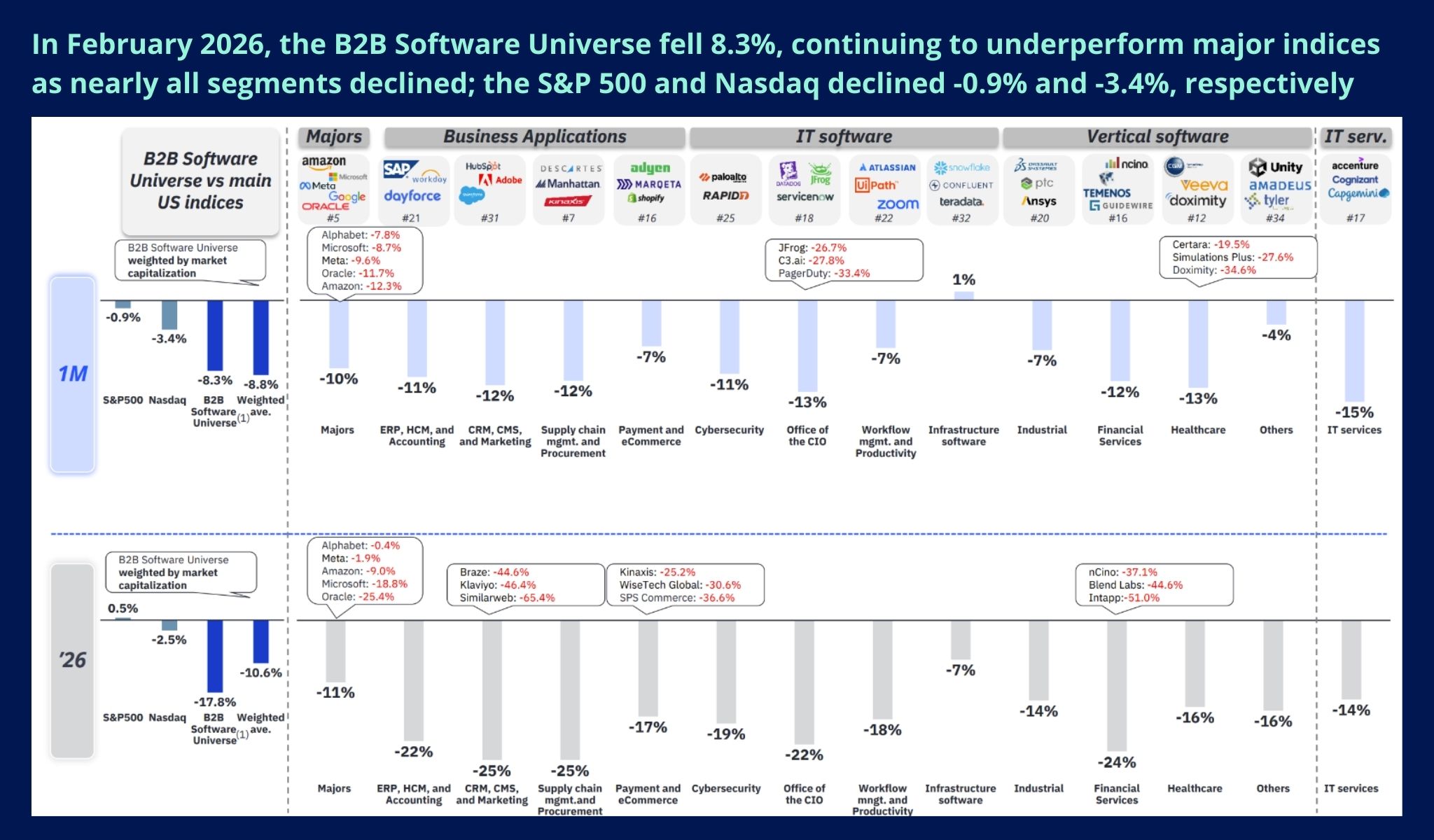
The sell-off has been broad-based across nearly all software clusters. Most segments declined by roughly 15–20%, highlighting a widespread repricing of software equities. The only notable exception was infrastructure software, which remained slightly positive thanks to its proximity to data infrastructure and AI workloads.
The correction reflects a growing reassessment of the sector’s risk profile. Investors are increasingly pricing in the impact of AI disruption, which challenges the long-standing perception of software as a structurally high-growth and low-risk asset class.
Market Valuations
Valuations compressed significantly in line with the equity correction.
• EV/Sales: 4.2x (down from 5.6x at the end of 2025)
• EV/EBITDA: below historical pandemic-era levels
• High-growth companies (>20% growth): declining multiples alongside broader market compression
• Rule of 40 companies: still trade at a premium but multiples continue to decline
• NA vs EU premium: remains elevated, supported by stronger growth expectations in North America
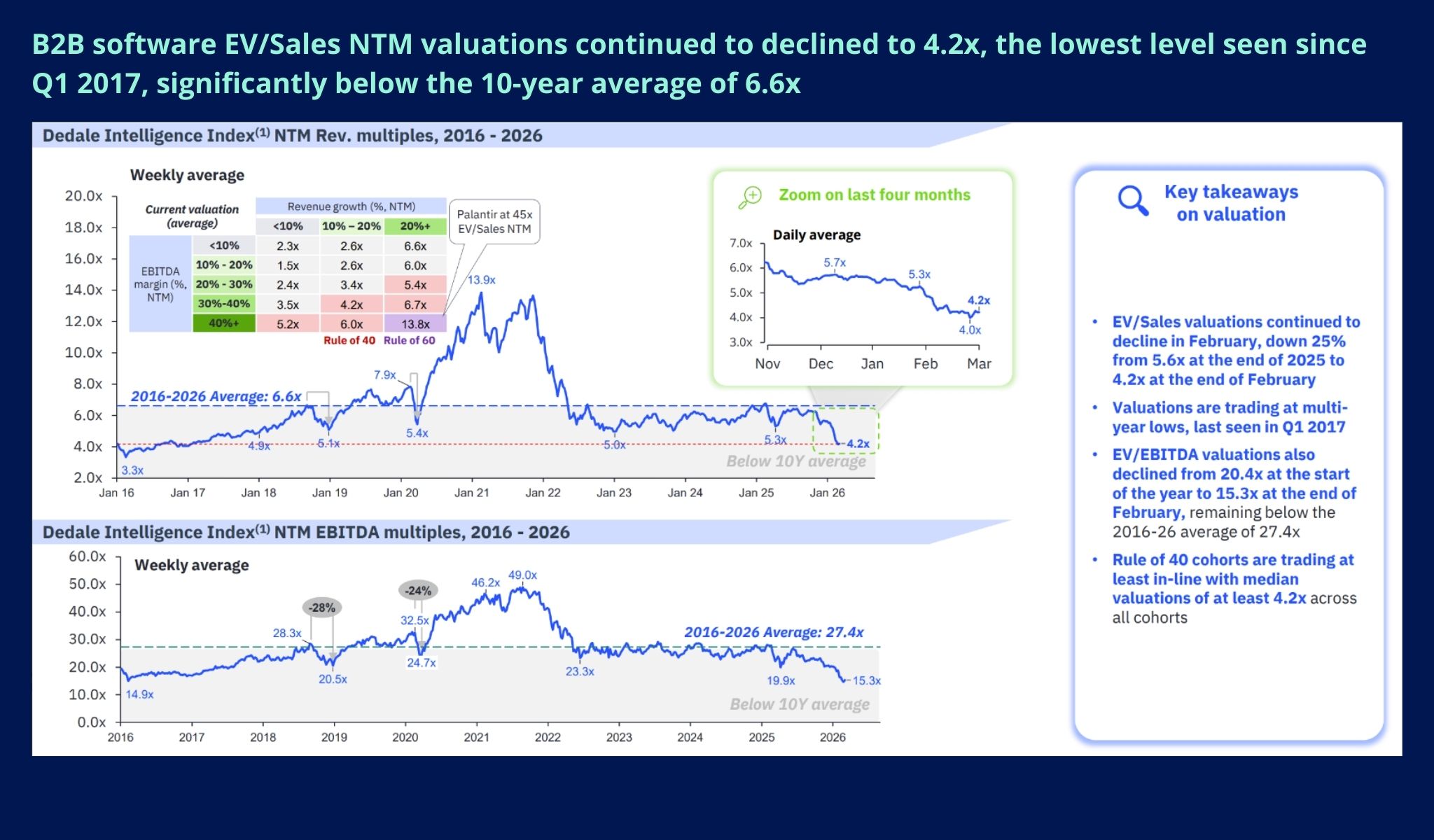
Overall, EV/Sales multiples for the B2B software universe have declined ~25% year-to-date, reflecting one of the most rapid valuation adjustments in recent years.
Despite this decline, some investors view the current environment as potentially attractive for long-term entry points, as valuation levels are now below those observed during the early stages of the 2020 pandemic.
Want the full breakdown behind these trends? Download the complete Market Intelligence report to explore detailed data, company-level benchmarks, and deeper analysis across all B2B software segments.
Deal Flow
M&A and venture activity continues despite the public market correction, with several notable transactions across both horizontal and vertical software segments.
Notable transactions included:
• ITRS acquisition of Ekara, expanding monitoring capabilities in the IT operations management space.
• Menlo Ventures’ $330M investment in Lovable, a rapidly emerging disruptor in developer productivity software.
• Kraken raising $800M, a major financing round for the European vertical SaaS leader focused on energy platform software.
In addition, consolidation continues in field service management software, highlighted by the merger of Totalmobile and Solvaris, backed by Five Arrows.
These deals illustrate sustained investor interest in infrastructure software, vertical SaaS, and developer productivity platforms despite public market volatility.
What to Watch
IPO Momentum and Public Market Sentiment
IPO activity in B2B software remains extremely limited. No significant software IPOs were recorded during the period, reflecting weak market sentiment, declining SaaS valuations, and poor post-IPO performance for recent listings.
Until market conditions stabilize, IPO activity in the sector is expected to remain subdued.
Macro Stability, Valuation Gaps Persist
Macro conditions remain a key driver of technology market volatility.
The current correction reflects a combination of factors:
• Persistent macro uncertainty
• Repricing of technology equities
• Investor concerns about AI disruption
• Sector rotation toward defensive industries
As the market recalibrates the cost of capital and future growth expectations, valuation dispersion across software segments is increasing.
Segment Trends and Earnings Insights
Recent developments highlight diverging prospects across software segments.
Infrastructure-oriented companies, such as Cloudflare and Datadog, continue to benefit from AI adoption, as their platforms enable the infrastructure required to run and secure AI workloads.
Conversely, segments relying heavily on seat-based pricing models are facing increased skepticism, as AI tools reduce the need for large user bases.
At the same time, industry-specific software providers with proprietary data, such as Bentley Systems and PTC, are seen as relatively well protected from AI disruption.
Software companies are also adapting operationally. Many vendors are increasingly using AI to deliver the same output with fewer employees, a trend already visible in several technology firms.
Finally, vendors are shifting their go-to-market strategies toward large enterprise clients, where demand for platform consolidation and vendor rationalization is increasing.
Want access to the full market session? Download our complete Market Intelligence report.
Dedale’s market update provide a curated, data-driven lens into what’s really happening in B2B software, from valuations and macro trends to investment signals and segment-level dynamics.
Want to go deeper on a specific segment, deal, or valuation trend from this month's update? Talk to our team? Contact us

Explore our resources

AI in GovTech: A Low-Disruption Market Where Incumbents Hold the Advantage

The SaaSPocalypse & What Comes Next with Vladimir Lasocki (Carlyle)
Frequently asked questions
March 2026 Market Trends: Common Questions
Answers to the most common questions about Dedale's February 2026 B2B software and IT services market update.
How did B2B software equities perform in February 2026?
The B2B Software Universe fell 8.3%, underperforming the S&P 500 (down 0.9%) and Nasdaq (down 3.4%), with nearly all segments declining 15 to 20% except infrastructure software.
How far did valuations fall in February 2026?
EV/Sales multiples declined to 4.2x from 5.6x at the end of 2025, a roughly 25% year-to-date drop, one of the most rapid valuation adjustments in recent years.
What were the notable deals in February 2026?
ITRS's acquisition of Ekara, Menlo Ventures' $330 million investment in Lovable, Kraken's $800 million raise, and the merger of Totalmobile and Solvaris backed by Five Arrows.
Newsletter
Fresh insights, straight to your inbox
Trusted by 2,000+ clients
Get started
Investor, operator, or industry expert, there's a path for you.