Anthropic: The Enterprise AI Leader Reshaping the Foundational Model Market
Dedale's Private Market Leader 360 on Anthropic covers competitive positioning, enterprise adoption, product strategy, and market dynamics across the foundational AI model landscape.

Foundational models have become the core infrastructure layer of the modern AI stack, powering the assistants, code tools, and automation workflows that enterprises now deploy at scale. At the centre of this market sits Anthropic, one of a small group of players competing for dominance in a rapidly consolidating landscape.
Dedale Intelligence's Private Market Leader 360 on Anthropic examines how the company has built one of the most commercially distinctive positions in enterprise AI, what is driving its growth, and where the structural strengths and risks lie. This article draws on selected findings from that report.
What are foundational models?
Foundational models are large-scale AI systems trained on vast and diverse datasets, offering general adaptability and complex reasoning. They act as the base layer of the AI value chain, enabling specialised applications across coding, document analysis, customer-facing automation, and enterprise workflows. Adoption is expanding from internal productivity pilots to production-grade deployments, with agentic workflows emerging as the next major frontier.
For a broader view of how the AI ecosystem is structured across its five layers, from hardware to applications, see Dedale Intelligence's AI Models and Architecture Overview.
The competitive landscape: a concentrated model layer
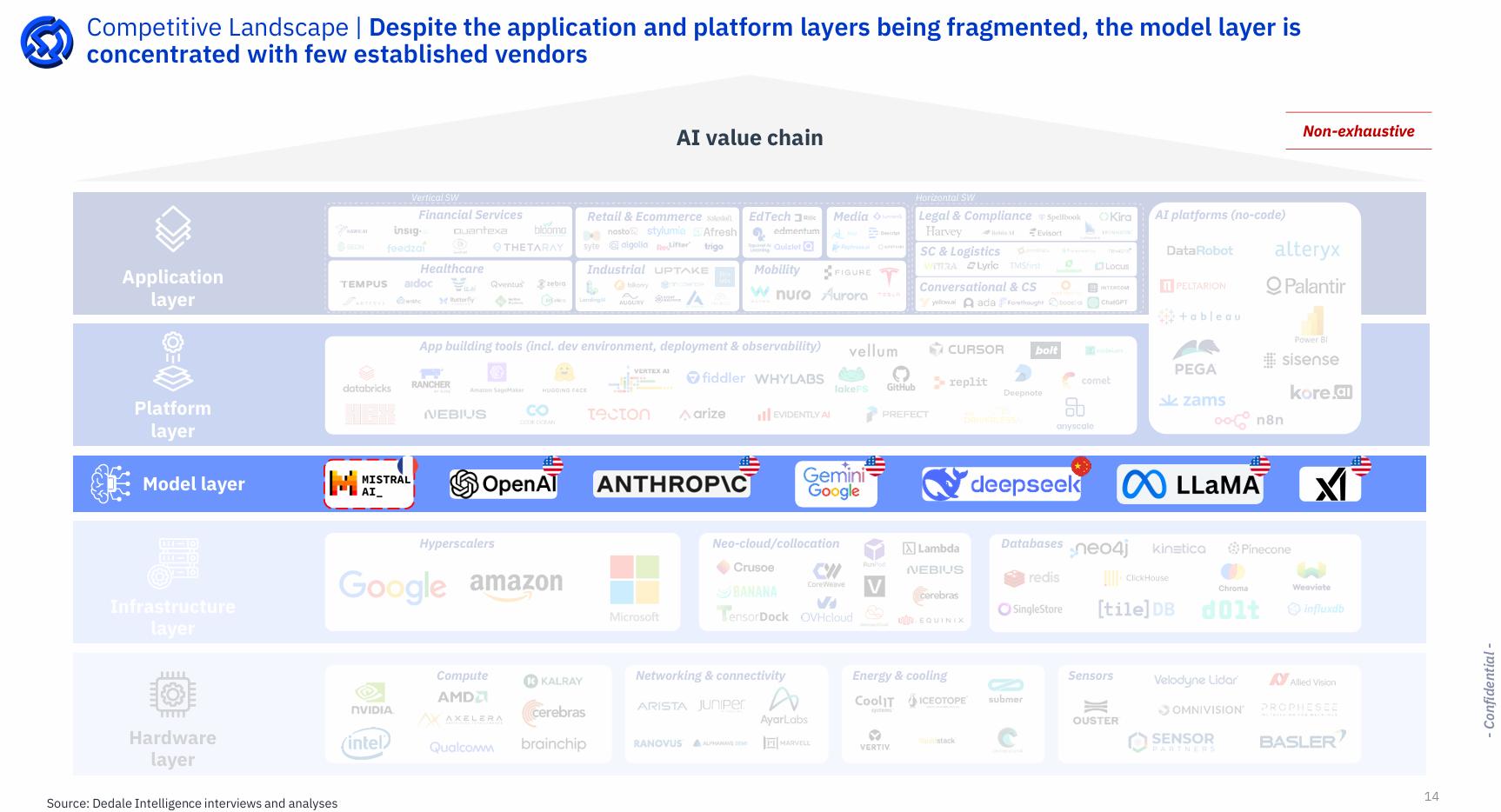
Despite fragmentation at the application and platform layers, the model layer is dominated by a handful of players. Vendors are increasingly blurring boundaries: model makers launching end-user applications, hyperscalers turning infrastructure into managed platforms, and capital-heavy firms locking GPU supply through long-term contracts.
Anthropic: company snapshot
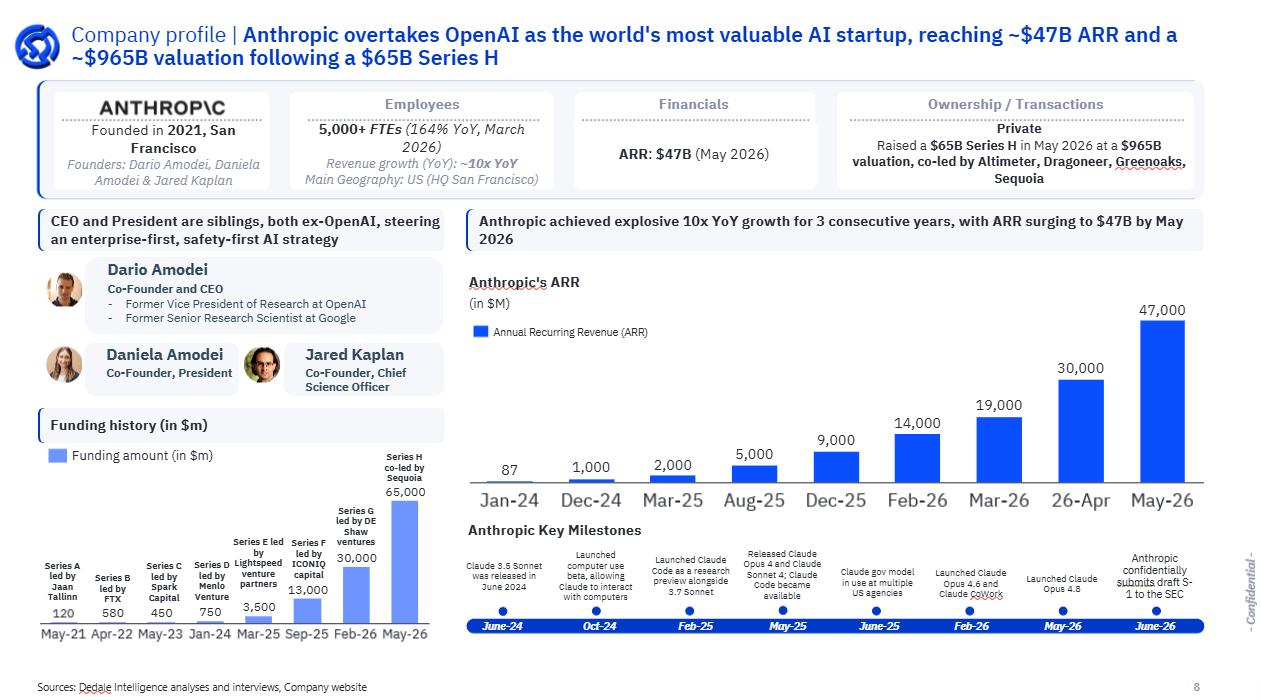
- Founded: 2021, San Francisco
- Founders: Dario Amodei (CEO), Daniela Amodei (President), Jared Kaplan (Chief Science Officer): all former OpenAI researchers
- Employees: 5,000 FTEs as of March 2026, up 164% year-on-year
- ARR: $47B as of May 2026, up from $9B at end-2025: approximately 10x year-on-year growth for 3 consecutive years
- Valuation: $965B following a $65B Series H in May 2026, co-led by Altimeter, Dragoneer, Greenoaks, and Sequoia
- Revenue model: enterprise-first, API-driven, approximately 80% of revenue from business customers
- Distribution: AWS Bedrock, Google Vertex AI, Databricks, and Microsoft Azure Foundry
- Customers: 1,000 enterprises spending over $1M annually; 8 of the Fortune 10 are Claude customers
Product portfolio overview
- Claude (API Platform and Chat Interface): flagship product, approximately 90% of revenue. Tiered model architecture: Opus for high-complexity reasoning, Sonnet as the enterprise production workhorse, and Haiku for high-volume latency-sensitive applications.
- Claude Code: agentic coding tool living natively in the developer terminal. Reads and edits entire codebases autonomously. Reached $2.5B ARR as a standalone product within nine months of launch.
- Claude CoWork: extends the agentic model to all knowledge workers. Automates spreadsheets, documents, and cross-application workflows via 11 pre-built role-specific plugins and 190 MCP connectors.
Who Anthropic serves
Anthropic's sweet spot is high-tech-maturity enterprises where safety architecture and compliance depth create a defensible competitive position. Four primary customer segments:
- Tech-savvy enterprises: embed Claude via API into customer-facing products requiring advanced reasoning and long-context processing
- Internal teams: deploy Claude CoWork for knowledge worker automation across sales, legal, finance, and HR
- Startups and developers: use Claude Code and the API for rapid AI-native product building
- Regulated enterprises: financial services, healthcare, and legal buyers where Constitutional AI and pre-built compliance guardrails are procurement prerequisites, not preferences
Where Anthropic wins and where it faces headwinds
Dedale Intelligence's primary research across 20 expert interviews with Anthropic alumni, customers including IBM and Cleary Gottlieb Steen and Hamilton, and competitors surfaces a consistent picture.
Enterprise customers consistently highlight coding quality, long-context reasoning, and instruction-following as superior to alternatives. IBM has integrated Claude across internal HR chatbots and enterprise Watsonx deployments. Cleary Gottlieb uses Claude for agentic legal workflows and complex document synthesis, citing hallucination resistance as a genuine competitive edge over alternatives.
The friction points are equally consistent. Multiple customers independently describe Anthropic as startup-like in enterprise vendor maturity relative to hyperscalers, creating procurement friction for highly sensitive workloads. API reliability and the absence of on-premise deployment options remain structural limitations.
Contact the Dedale Intelligence team to discuss the findings, go deeper on a specific theme, or explore how our foundational model coverage can support your investment or strategic research needs.
Competitive dynamics: gaining share, but the race is tightening
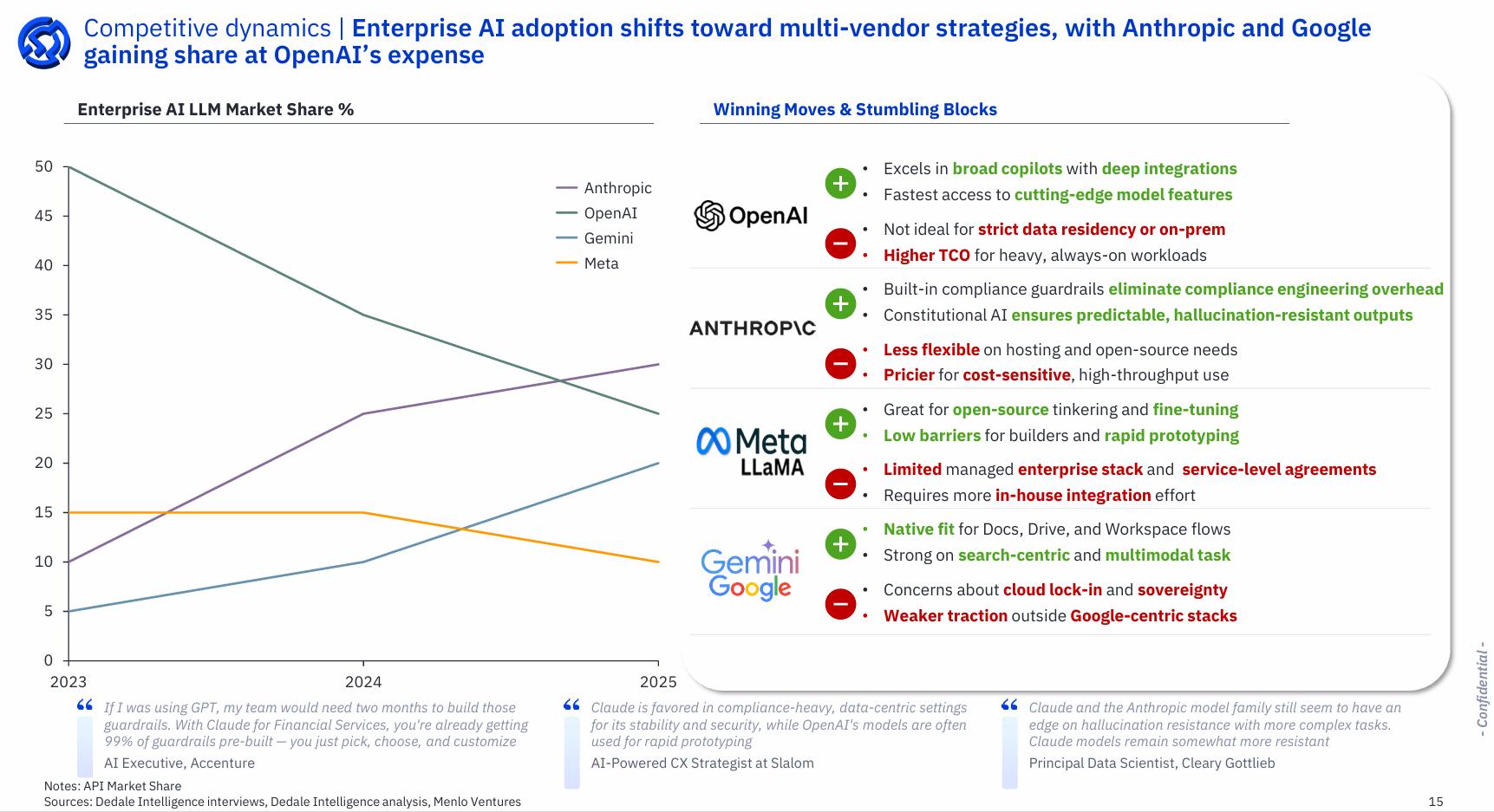
Enterprise AI adoption has shifted toward multi-vendor strategies. Anthropic has been gaining share in compliance-heavy and coding-intensive use cases, while OpenAI maintains its dominant overall position, Google Gemini gains ground through Workspace bundling, and Meta's LLaMA leads open source.
Based on Arena AI's ELO benchmarking, which measures real-world side-by-side performance by technical users, Anthropic's flagship models achieve the highest average scores across text-to-text tasks, agentic coding, and document analysis as of March 2026. However, OpenAI's latest model leads on complex problem-solving benchmarks, and its Codex launch has already begun to compress Anthropic's agentic coding lead.
For broader context on how AI investment and deal activity are shaping the competitive dynamics in this space, see Dedale Intelligence's May 2026 Market Trends update.
Growth factors and structural risks
Key growth drivers:
- Constitutional AI as an enterprise moat: safety embedded at model level makes Claude the default in regulated industries where auditability is a procurement prerequisite
- Claude Code flywheel: the fastest B2B product ramp in software history at $2.5B ARR in nine months, pulling enterprise API and CoWork adoption behind it
- Tri-cloud distribution: the only frontier model available natively across AWS, Google Vertex AI, and Microsoft Azure simultaneously, removing the last enterprise procurement blocker
Structural risks:
- Compute dependency on AWS and Google Cloud, both direct model competitors, creating margin and continuity exposure
- Coding revenue concentration: a disproportionate ARR share is driven by Claude Code, and OpenAI Codex has already narrowed this lead
- Enterprise vendor maturity gap: persistent procurement friction for highly confidential workloads where institutional track record matters more than model performance
How Dedale Intelligence researches the foundational model market
Dedale Intelligence's Private Market Leader 360 on Anthropic is built on 20 primary expert interviews across Anthropic alumni, enterprise customers, and competitors. The research covers competitive positioning, enterprise purchasing dynamics, product strategy, market share benchmarking, and detailed customer case studies at named enterprise accounts.
This report is part of Dedale Intelligence's continuous coverage of the AI market for private equity investors, corporate development teams, and M&A advisors evaluating opportunities across the foundational model and broader AI value chain. For a structural overview of the full AI ecosystem, see Dedale Intelligence's Artificial Intelligence Strategic Overview and our AI fundamentals learning series.
At Dedale Intelligence, we provide strategic intelligence across 1000+ software markets, including deep dives into financial management ecosystems, vendor landscapes, and technology trends. If you are evaluating your current setup or exploring this space, contact us to access the full research or explore our platform.

Explore our resources

Software Market Trends, October 2026: Rate Hikes Hit Valuations, GRC Attracts AI Capital
.png)
AI-Native Patents: How Lightbringer Is Rebuilding IP for the Agent Era | Dominic Davies, Lightbringer
Frequently asked questions
Anthropic: Common Questions
Answers to the most common questions about Anthropic's position in the foundational AI model market, from Dedale's Private Market Leader 360.
What is Anthropic's revenue and valuation?
Anthropic reached $47 billion in ARR as of May 2026, up from $9 billion at end-2025, roughly 10x year-on-year growth for three consecutive years. Its valuation stands at $965 billion following a $65 billion Series H in May 2026.
How does Anthropic generate revenue?
Anthropic is enterprise-first and API-driven, with approximately 80% of revenue coming from business customers. It distributes through AWS Bedrock, Google Vertex AI, Databricks, and Microsoft Azure Foundry.
What is Anthropic's flagship product?
Claude, spanning an API platform and chat interface, represents approximately 90% of revenue, with a tiered model architecture: Opus for high-complexity reasoning, Sonnet for enterprise production, and Haiku for high-volume latency-sensitive applications.
How concentrated is the foundational model market?
Despite fragmentation at the application and platform layers, the model layer is dominated by a handful of players, with model makers, hyperscalers, and capital-heavy firms increasingly blurring boundaries between infrastructure, platforms, and applications.
Newsletter
Fresh insights, straight to your inbox
Trusted by 2,000+ clients
Get started
Investor, operator, or industry expert, there's a path for you.