

What’s next for healthcare software? From fragmentation to AI, discover key insights from Christophe Boutin, former CEO of Maincare Solutions
Written by :
Clémence Bouffard
March 23, 2026
Healthcare software sits at the intersection of critical infrastructure, regulatory complexity, and long-standing inefficiencies.
Despite decades of investment, hospitals still rely on fragmented systems that struggle to communicate with one another. The promise of digital transformation is real, but its execution remains uneven.
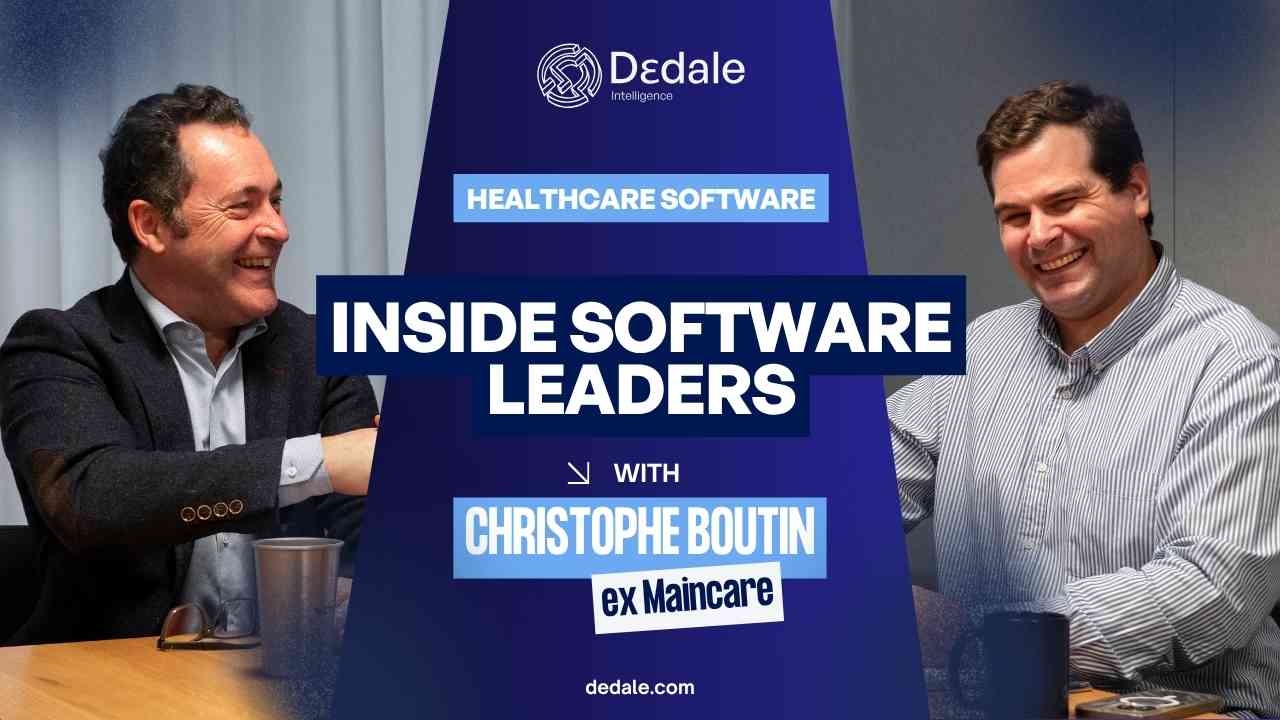
To better understand where the market stands today and where it is heading, Benjamin Forlani, Founder & CEO, Dedale Intelligence, sat down with Christophe Boutin, former CEO of Maincare Solutions, to discuss the structural challenges and future of healthcare software.
🎥 Watch the full interview
🎧 Listen to the podcast
One of the defining characteristics of healthcare software is its fragmentation. Unlike other software sectors that benefit from global scale, this market remains deeply local, shaped by national regulations, healthcare systems, and procurement processes.
As Christophe Boutin puts it:
“You have very complex needs, but a relatively small market. Finding the right balance is not easy.”
This structural imbalance explains why the market is still dominated by regional players rather than global champions. It also limits investment capacity, slows down innovation, and creates persistent gaps between what healthcare systems need and what software providers can deliver.
These dynamics are echoed in our work with healthcare CIOs across Europe and North America, where interoperability and vendor fragmentation remain key challenges.
Interoperability is often framed as a technological challenge. In reality, it is primarily an economic one.
“It’s not the technology anymore. We have the standards. The issue is financing.”
Connecting systems requires significant investment, custom integrations, and long deployment cycles. In many cases, no single stakeholder is incentivized to fund these efforts, resulting in persistent data silos and limited efficiency gains.
This insight fundamentally changes how the market should be approached: solving interoperability is less about innovation, and more about aligning incentives.
The transition from on-premise software to SaaS has been one of the defining shifts of the past decade. Today, this transition is largely complete.
“This battle is more or less over.”
The next phase of transformation will instead focus on data architecture, interoperability layers, and real-time connectivity. This is where new value is being created and where new players are emerging.
Artificial intelligence is often portrayed as a disruptive force. In healthcare software, its impact is likely to be more progressive.
“Technology will help, but only if combined with deep clinical expertise.”
Rather than replacing existing systems, AI will increasingly be embedded within them, enhancing decision-making, improving workflows, and supporting clinical operations.
More broadly, we are seeing similar dynamics across multiple software verticals, as AI becomes a layer embedded into existing products rather than a standalone replacement.
While legacy systems remain constrained, new opportunities are emerging around data and connectivity.
“This new segment will likely grow faster than legacy software.”
Data platforms, interoperability layers, and AI-enabled tools are less constrained by legacy architectures and more scalable across geographies. As a result, they are attracting increasing attention from investors and operators alike.
Looking ahead, the market is likely to move toward greater consolidation.
“You need critical mass to move forward.”
Scale will be essential to support R&D investment, improve product quality, and compete internationally. At the same time, smaller players may struggle to keep up, leading to a gradual reshaping of the competitive landscape.
Healthcare software remains one of the most complex, and most promising, segments in technology.
The next wave of transformation will be driven not by infrastructure alone, but by data, connectivity, and AI. While structural challenges remain, the direction is clear: the market is moving toward greater integration, scale, and intelligence.
If you are an investor, operator, or corporate exploring healthcare software, or more broadly software markets, we would be happy to exchange and share our perspective.
About the series
This interview is part of our Inside Software Leaders series, where we speak with leading operators and industry experts across global software markets.
At Dedale Intelligence, we support investors and corporates in assessing software markets, including complex verticals such as healthcare. You can explore our latest research on the digital transformation of healthcare IT and our broader perspective on the HealthTech space.
Get started
Dedale is growing fast and we are continuously looking to widen our reach in the ecosystem. Let's connect!
Members
Join our Community of Industry Veterans that we collaborate with to conduct deep research
Join the community
Investors, Corporates, and M&A Advisors
Learn more about how collaborating with Dedale Intelligence could enhance your intelligence generation efforts
Request an introduction
Talents
We are looking for smart, hungry, humble individuals to join our fast growing team worldwide!
Join the team





.avif)
.avif)

.avif)
.avif)
.avif)

.avif)
.avif)
.avif)
.avif)